
 Search


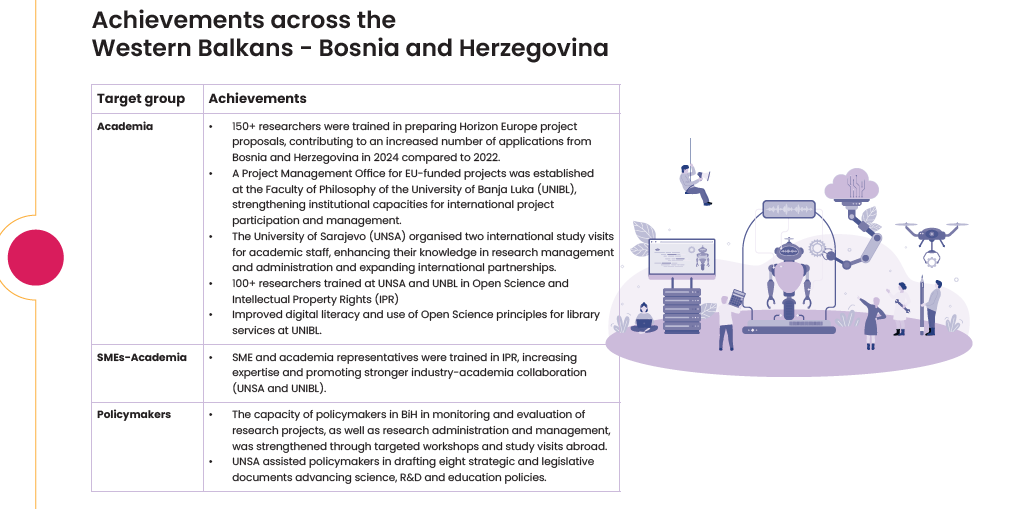
POLICY ANSWERS project partners have played an instrumental role in establishing and sustaining cooperation between research and innovation stakeholders in Bosnia and Herzegovina, their counterparts in other Western Balkan economies and relevant actors in EU Member States. Importantly, this cooperation has gone beyond the formal policy dialogue work packages and has translated into tangible capacity-building effects, institutional learning and the concrete uptake of project results by ministries, universities and intermediary organisations.
Both partners, University of Sarajevo (UNSA) and University of Banja Luka (UNIBL) have maintained regular contact with respective ministries throughout the project, sharing POLICY ANSWERS activities and results through dedicated meetings with policy-makers at the Ministry of Civil Affairs of Bosnia and Herzegovina, the Ministry of Science, Higher Education and Youth of Canton Sarajevo and the Ministry of Scientific and Technological Development and Higher Education of the Republic of Srpska. University management at both institutions demonstrated continuous interest in the project’s progress and outputs, which facilitated internal uptake and institutional follow-up.
A particularly illustrative example is the role of UNSA in facilitating structured contacts between stakeholders from Bosnia and Herzegovina and counterparts in Slovenia. Through a targeted study visit to Ljubljana, UNSA and UNIBL enabled direct exchanges between representatives of the Slovenian Ministry of Higher Education, Science and Innovation, the Slovenian Public Agency for Research and Innovation (ARIS) and University of Ljubljana and policy-makers from Bosnia and Herzegovina, including representatives of the Canton Sarajevo and Republika Srpska authorities responsible for science such as the Ministry of Scientific and Technological Development and Higher Education of Republika Srpska. These interactions strengthened the capacities of BiH policy makers to reflect on public research funding models and governance arrangements and directly informed the discussion and adoption of good practices in the BiH context.
At entity level, UNIBL supported policy coordination and dialogue through a series of dedicated meetings with the Ministry of Scientific and Technological Development and Higher Education of the Republic of Srpska. These meetings were explicitly focused on planning activities supported by POLICY ANSWERS, aligning them with ministerial priorities and discussing the dissemination and further use of project results. A joint workshop organised for the Ministry together with the Ministry of Education on the topic of monitoring and evaluation of strategic documents represents a concrete outcome of this cooperation. The workshop strengthened administrative and analytical capacities for evidence-based governance and introduced practical tools and approaches for monitoring the implementation of strategic documents in the research and education domains.
At the national level, POLICY ANSWERS partners contributed to dialogue structures linked to Bosnia and Herzegovina’s participation in Horizon Europe. A meeting of the Joint Committee between Bosnia and Herzegovina and the European Union for the Horizon Europe research and innovation programme was held in Sarajevo, organised by the Ministry of Civil Affairs and attended by representatives of entity and cantonal ministries responsible for science and the economy, as well as universities. Participation of a representative from UNIBL ensured that insights from project activities and institutional-level challenges were reflected in the national-level discussion, further strengthening vertical coordination across governance levels.
The impact of various interactions is visible in ongoing policy processes. The Research Strategy of Canton Sarajevo (draft adopted in January 2025) incorporates several good practices discussed during POLICY ANSWERS-supported exchanges, including the introduction of an independent fund for financing research activities and the systematic development of technology transfer offices and R&D centres at public research and higher education institutions.
POLICY ANSWERS partner UNSA also prepared concrete comments and suggestions for amendments to the Cantonal Law regulating scientific research, with the aim of harmonising it with EU standards and creating a more favourable framework for innovation and knowledge transfer.
Capacity-building activities at institutional level further reinforced these effects. Trainings and study visits organised within POLICY ANSWERS created a solid basis for new initiatives, particularly in the areas of knowledge and technology transfer, open science practices and discussions on increasing and better targeting public support to research activities. In this context, for example, UNSA organised a targeted study visit to the University of Split, engaging with its Department for Science and Innovation, the Office for Technology Transfer, the Office for Research and Development and the Centre of Excellence for Science and Technology. This visit provided comprehensive insights into institutional support structures across the research and innovation lifecycle and strengthened bilateral contacts that can be further exploited in future cooperation.
Regional peer learning was also supported through fellowships, for example the one hosted by IMP in Serbia which contributed significantly to UNIBL’s stakeholder engagement and strategic positioning in the regional research and innovation landscape. During a two-week study visit, the UNIBL representative engaged in intensive one-to-one exchanges and team meetings focused on research infrastructure management, project management practices and future collaboration opportunities. Beyond the host institution, the visit opened access to high-level contacts in Belgrade, including representatives from the Innovation Centre at the Faculty of Mechanical Engineering, the Intellectual Property Office of the Republic of Serbia and the Institute of Physics. The insights gained informed concrete ideas for follow-up activities and the transfer of good practices to UNIBL, supporting its deeper integration into regional and European research networks.
Various dissemination and mobilisation channels were used to promote the WB Mobility Scheme and WB Innovation Vouchers multiple touchpoints where POLICY ANSWERS and regional pilots were promoted to national and EU audiences and local researchers included a BiH–EU conference and a Horizon Info Day in Sarajevo, plus a dedicated UNIBL-facing outreach moment. International research-infrastructure networking via DARIAH-EU national coordinators, study visits (e.g., Copenhagen Business School; University of Rijeka; Ljubljana ecosystem) and other activities also strengthen the “internationalisation” dimension and other external links.
A particularly strong illustration of the concrete impact and added value of POLICY ANSWERS support is the successful preparation and submission of the Twinning Bottom-Up project RETLAMI-SEE (Enhancing Capacities for Quality and Impactful Research on Transformations, Labour and Migration in Southeast Europe), coordinated by UNIBL and awarded the maximum evaluation score of 15/15. The project strengthens UNIBL’s research and management capacities through strategic networking, peer learning, mentoring and joint exploratory research with established European partners, thereby positioning the university more firmly within the European Research Area. Given that the successful proposal preparation was directly supported by POLICY ANSWERS capacity building activities, this achievement provides clear evidence of how targeted activities and stakeholder cooperation translate into competitive EU-level funding success and long-term institutional benefits. The strategic training track for a staff member at UNIBL who becomes head of a newly opened Project Management Office at the Faculty of Philosophy and other activities lead to measurable growth in funded Horizon Europe, IPA and Interreg projects across 2022–2025: over the 4 years of the project duration, the numbers of Horizon and IPA/Interreg projects won by UNIBL increased from 1 in 2022 (as beneficiary) to 4 in 2023 (as beneficiary), 3 in 2024 (2 as lead partner and 1 as beneficiary) and reached 6 in 2025 (2 Horizon projects and 4 IPA/Interreg all as beneficiary). POLICY ANSWERS-supported training and proposal support also contributed to strengthening UNSA’s ability to assume the leadership role in competitive Horizon Europe consortia of STECCI – “Stone monument ensembles and the climate change impact”, which was selected under the HORIZON-CL2-2022-HERITAGE-01-08 call.
A further important impact is the institutionalisation of activities related to intellectual property rights (IPR) governance and Open Science at both partner universities. Following targeted capacity-building activities and expert-supported needs assessments, Open Science principles and IPR considerations are embedded into formal institutional policies, procedures and support structures rather than remaining ad hoc or project-based initiatives. These activities were also explicitly linked to existing and previous European initiatives (such as OpenAIRE, EOSC, NI4OS Europe and WBC-RRI.NET), ensuring coherence and facilitating long-term sustainability through established infrastructures and routines.