
 Search


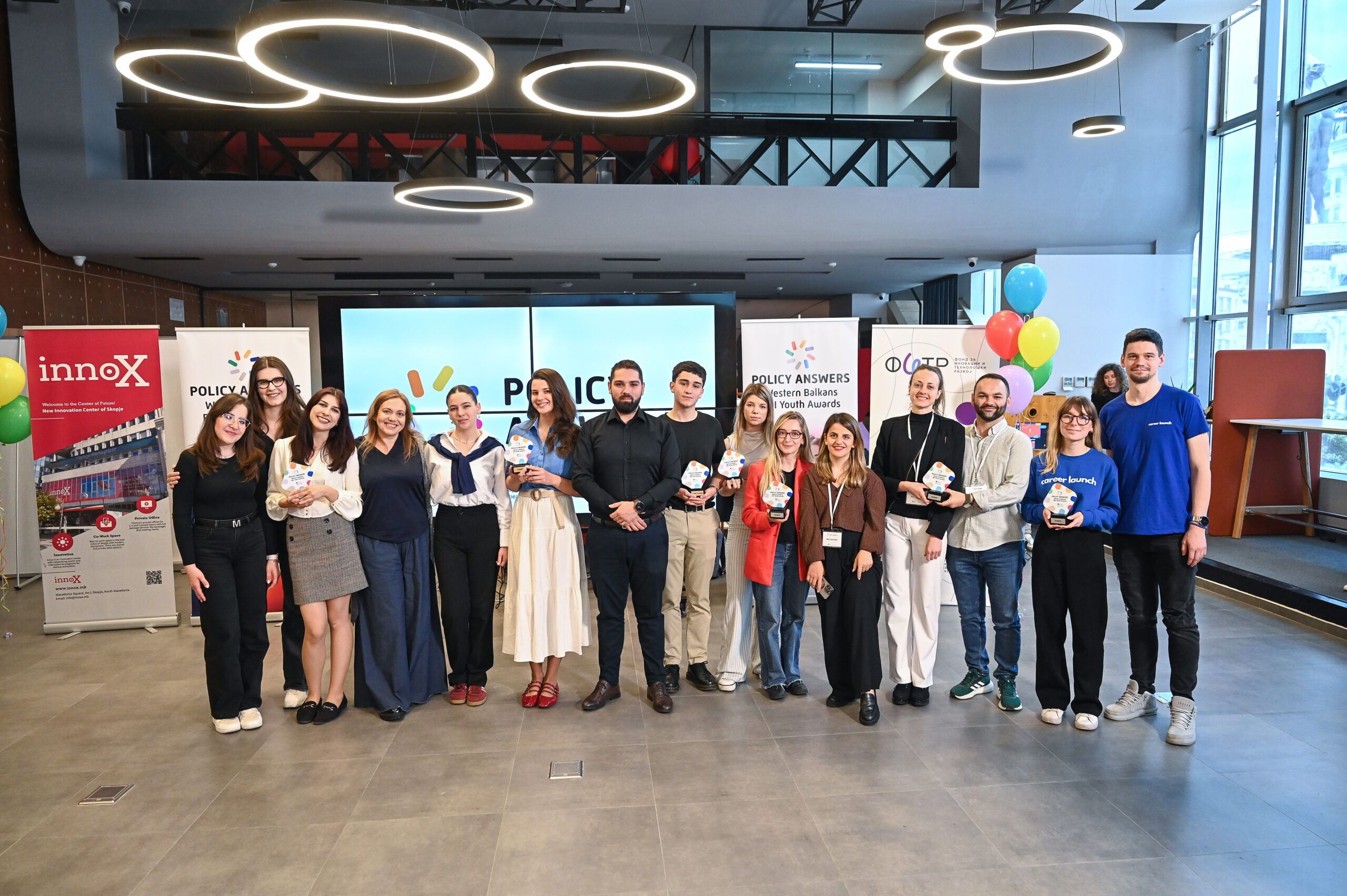
The Western Balkan Research & Innovation Youth Awards pilot has demonstrated a compelling truth about the region’s future: youth-led innovation is not a latent potential waiting to be discovered, but an active force already shaping resilient, future‑oriented ecosystems across the Western Balkans. Through a targeted regional promotion campaign, the initiative successfully activated this energy, delivering visibility, recognition, and evidence-based insights that can inform the next generation of research and innovation (R&I) policy and investment.
The winners are listed below and you’ll be able to watch their short interviews.
| Price | Economy | Winner |
|---|---|---|
| Grand Winner | North Macedonia | Regional Advocacy Centre |
| Winner | Serbia | Career Launch |
| Winner | Bosnia and Herzegovina | Fondacija za inovacije, tehnologiju i transfer znanja |
| Winner | Kosovo* | Caritas |
| Winner | Montenegro | NGO Center for youth education |
| Winner | Albania | Together for life |
Launched under the POLICY ANSWERS project, Youth Awards were conceived as a flagship instrument to promote youth engagement, support researcher mobility, and stimulate cross-border collaboration throughout the Western Balkans. The call for applications, open from 18 February to 18 April 2025, attracted 65 submissions from all six Western Balkan economies. This level of participation alone confirmed a strong appetite for recognition and connection within the youth R&I community. Following administrative screening, 41 high-quality success stories advanced to jury evaluation, underscoring both the quantity and quality of grassroots innovation activity across the region.
The process culminated in a two-day pitching competition in Skopje, North Macedonia, on 29–30 May 2025. Twelve finalists, two from each economy, presented their initiatives, with six winners ultimately selected and awarded. The award ceremony marked the official launch of the regional promotional campaign, which ran from June to November 2025 and served as a powerful amplifier of youth-led innovation narratives.
One of the most significant findings of the Awards pilot is the central role played by civil society organisations (CSOs). Over half of all applications (56.9%) originated from CSOs and non-profit organisations, far outpacing submissions from small and medium enterprises, educational and research institutions, or governmental actors. This confirms that civil society remains the primary engine for community-level engagement, capacity building, and experimentation in youth R&I across the Western Balkans.
From a thematic perspective, the majority of initiatives focused on R&I capacity building (63%), followed by digital transformation and STEM, entrepreneurship and employability, and green transition and sustainability. Together, these themes reflect a strong alignment with regional policy priorities and labour-market needs, while also highlighting the breadth of approaches used to engage young people, from advanced robotics training to circular economy start-ups and social entrepreneurship programmes.
A unifying feature across the six winning initiatives was a strong emphasis on experimental, hands-on learning. Rather than abstract training models, the most impactful projects placed young people in real-world environments where they could learn by doing, testing, failing, and iterating.
The Grand Winner from North Macedonia exemplifies this approach. Focused on sustainable electronic waste management, the initiative established fully equipped repair hubs in three municipalities, integrating environmental responsibility with youth entrepreneurship. Young participants learned to diagnose, repair, and repurpose electronic equipment, transforming waste into economic and social value. The project collected 1,500 kilograms of electronic waste, restored ten per cent to active use, and reached more than 10,000 citizens through public awareness campaigns.
Similarly, the winning initiative from Bosnia and Herzegovina addressed the digital skills gap through Industry 4.0 training in robotics, automation, and CNC technologies. By offering certified, practice-oriented learning in simulation labs, the project directly linked education to employability, enabling participants to transition rapidly into high-demand jobs and helping to counteract brain drain.
Across Serbia, Kosovo*, Montenegro, and Albania, winning projects demonstrated how experimental learning can drive employability, social entrepreneurship, and creative industries. Whether through personalised career mentoring, regional vocational training schemes, social impact competitions, or the fusion of cultural heritage with digital fashion technologies, each initiative translated learning into tangible outcomes.
The Youth Award achieved full regional coverage, with applications from all six Western Balkan economies. North Macedonia recorded the highest number of submissions, accounting for more than 40 per cent of the total, reflecting strong community mobilisation and outreach. Serbia, meanwhile, demonstrated exceptional proposal quality, with all submitted applications passing the initial eligibility screening.
This geographic spread highlights both shared regional challenges and differentiated national strengths. Taken together, the results point to a diverse but interconnected ecosystem in which youth-led initiatives are already addressing skills gaps, employment pathways, sustainability challenges, and innovation capacity at local and regional levels.
The regional promotion campaign associated with the Awards successfully met all its objectives. It enhanced future-proof skills by identifying and amplifying proven experimental learning models. It boosted the visibility of youth-led success stories, ensuring sustained recognition through mandatory content contributions from awardees and finalists. Crucially, it encouraged careers in research and innovation by showcasing credible, inspiring pathways from learning to employment, entrepreneurship, and policy impact.
The campaign did more than promote individual projects; it validated an entire approach to youth engagement in R&I. By grounding innovation in practice and community needs, the Awards demonstrated that young people are not only beneficiaries of policy but active co-creators of solutions.
Investing in these proven, youth-led models, particularly those anchored in civil society and experimental learning, offers a high return. Such investment will sustain current momentum, scale successful practices, and strengthen the Western Balkans’ overall R&I capacity. More importantly, it will ensure that the region’s young innovators remain engaged, empowered, and equipped to drive inclusive economic development and deeper regional cooperation.