
 Search


POLICY ANSWERS organised several regional policy dialogue events in Montenegro and a series of national events with the focus on local capacity building and training needs.
The 2023 regional foresight workshop in Podgorica was rooted in broader activities to embed strategic foresight in research and innovation policy making in the Western Balkans. The workshop drew on various studies and used scenarios to stimulate joint future thinking among regional stakeholders. The inputs were designed to prompt stakeholders to anticipate change, stress-test extant innovation strategies and open discussion on structural reforms responsive to future trends.
In May 2025, a workshop focusing on Technology-Oriented Research Infrastructures also took place in Podgorica. It brought together policy makers, industry leaders, researchers and funding representatives to discuss how such specialised facilities, which are designed to support R&D with strong industrial and commercial orientations, can catalyse scientific and economic development across the Western Balkans. The workshop showcased several good practices and strategic approaches. By positioning this workshop back-to-back with a meeting of the Steering Platform on Research and Innovation for the Western Balkans, POLICY ANSWERS helped seed discussion on infrastructure development as a priority theme for the regional R&I agenda.
The Steering Platform meeting (13–15 May 2025) served as a key regional forum for in-depth dialogue on policy developments, cooperation priorities and strategic alignment between Western Balkans economies and EU R&I frameworks. Co-chaired by the European Commission, the EU Council Presidency and Montenegro on behalf of the region, the meeting convened policy makers, practitioners and stakeholders to discuss substantive thematic areas such as Smart Specialisation Strategies (S3) and the Marie Skłodowska-Curie Actions (MSCA), among others. The Steering Platform meeting also provided preparatory ground for the Ministerial Meeting later in the year.
The Ministerial Meeting of the Western Balkans Steering Platform on Research and Innovation in Podgorica (20–21 October 2025) was a strategic forum for high-level dialogue between Western Balkan leaders and European Commission representatives. It provided an opportunity to review progress on R&I collaboration, advance shared priorities and endorse strategic frameworks that sustain alignment with EU policies and funding mechanisms. The European Commissioner for Startups, Research and Innovation and ministers from the Western Balkans participated, alongside ambassadors from EU Member States, reflecting a multifaceted diplomatic and policy dialogue dimension. This high-level meeting reinforced the political commitment of Western Balkan economies to strengthening their research and innovation ecosystems, sustain capacity building and accelerate socio-economic convergence with EU norms and expectations.
The capacity-building programme implemented in Montenegro was characterised by a practice-oriented and institutionally embedded approach at the Science and Technology Park of Montenegro (STP-ME) as project partner who interacted on the planning with ministries, academia, business and civil society. The stakeholder cooperation evolved over the course of the project from ad-hoc engagement into formalised, sustained partnerships, resulting in clear exploitation of project outputs beyond the project’s lifetime. Another defining feature of the activities in Montenegro was the close alignment with EU accession priorities, notably Chapters 20 (Enterprise and Industrial Policy) and 25 (Science and Research), and with national strategic frameworks such as the Smart Specialisation Strategy (S3).
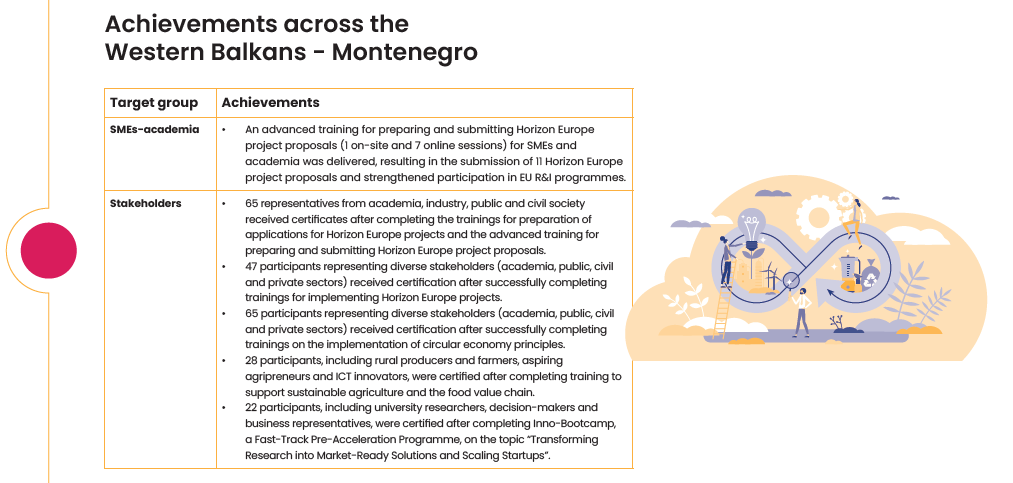
One of the impactful areas of cooperation concerned Horizon Europe proposal preparation and implementation, where STP-ME worked closely with the Ministry of Education, Science and Innovation, universities, research institutes, NGOs and National Contact Points. Two rounds of training on preparing Horizon Europe project applications were delivered in 2023 in Podgorica, significantly exceeding initial expectations: instead of the planned 15 participants, 44 researchers and practitioners from public and private universities, research organisations and NGOs participated across the two sessions. High demand led directly to repetition of the training within the same budgetary framework, demonstrating immediate stakeholder relevance.
Crucially, these activities went beyond short-term skills acquisition. Following the initial trainings, the Ministry of Education, Science and Innovation adopted the training model developed under POLICY ANSWERS and began delivering it independently as part of its regular capacity-building offer. This institutional uptake represents a clear example of exploitation of project results: training materials, methodologies and expert networks developed within the project were transferred into national structures and financed through domestic resources.
Building on this success, STP-ME and the Ministry jointly developed an advanced training programme for preparing and submitting Horizon Europe proposals in 2025. This programme combined an on-site session with up to seven months of individual online mentoring for selected teams. Fifteen teams from universities, research institutes and innovative organisations were supported through the full proposal development cycle, from consortium building to final submission. Eleven teams ultimately submitted proposals, some applying to multiple calls. This represents a qualitative shift from generic training towards hands-on proposal incubation, directly supporting Montenegro’s integration into the European Research Area.
A similar pattern was observed for the training on implementing Horizon Europe projects, delivered in two rounds in 2023. Again, participant numbers exceeded initial plans, and the Ministry subsequently embedded this training into its own portfolio. For stakeholders, the usefulness lay in acquiring practical skills related to financial reporting, audits, project management tools and post-project obligations. These are areas which had been repeatedly identified as bottlenecks in consultations. The repetition and institutionalisation of this training underline its perceived value and long-term relevance.
Another major highlight of stakeholder cooperation was the training programme on circular economy principles, which exemplifies adaptive implementation based on stakeholder feedback. Initially delivered as an intensive, multi-day programme in late 2024, the first iteration revealed challenges related to attendance and thematic breadth. In response, STP Montenegro redesigned the programme in 2025, by also consulting with and incorporating valuable inputs from the Chamber of Economy of Montenegro, into four targeted thematic workshops, each addressing a specific dimension of circular transition: CBAM and ESG compliance, public sector and civil society capacities, circular tourism and circular agriculture. This redesign significantly broadened engagement. Across the four workshops, 95 participants registered and 65 completed the training, representing ministries, local self-government, universities, business associations, ICT clusters (notably ICT Cortex), the Chamber of Economy, employers’ organisations and innovation support institutions. The modular structure allowed participants to select workshops most relevant to their roles, increasing both relevance and uptake and then to translate abstract concepts into concrete sector-specific applications. The programme generated reusable training formats and content that can be integrated into future innovation and sustainability initiatives.
Stakeholder cooperation was also extended beyond the capital to address regional disparities: Trainings on sustainable agriculture and food value chains were organised for example in Berane (north), Nikšić (central region) and Tivat (south), deliberately bringing capacity building closer to rural and semi-rural stakeholders. Participants included young farmers, agricultural producers, students, NGOs, ICT experts and representatives of the Ministry of Agriculture, Forestry and Water Management. The direct involvement of ministry representatives assigned to specific regions facilitated dialogue between producers and public administration and improved awareness of available support schemes. Although completion rates varied across locations, the trainings succeeded in establishing new links between farmers, innovation actors and public authorities, particularly in regions where access to advisory support is limited.
The introduction of the Inno-Bootcamp (Fast-Track Pre-Acceleration Programme) in 2025 marked an important expansion of the CB programme towards entrepreneurship and innovation commercialisation. Delivered at the premises of STP-ME with an internationally experienced expert, the three-day programme brought together 22 participants from academia, startups, innovation hubs, business associations and public institutions. The focus on transforming research results into market-ready solutions addressed a well-recognised weakness in Montenegro’s innovation ecosystem. Through mentoring, pitching exercises and exposure to investor perspectives, participants developed practical skills in validation, business modelling and strategic positioning. Dissemination through social media and professional networks further extended the programme’s reach, enhancing its visibility and impact. The Inno-Bootcamp complements existing incubation and mentoring services at the STP-ME, allowing its content and methodology to be reused and adapted in future programmes. This integration into the STP’s core activities ensures exploitation beyond the project context.
Across all activities, stakeholder cooperation in Montenegro was marked by depth, continuity and institutional anchoring. Ministries were not merely consulted but became co-owners and implementers of the activities; universities and research organisations moved from passive beneficiaries to active proposal developers; and business and innovation actors were engaged through tailored, practice-oriented formats.
Project results were systematically exploited through institutional adoption of training programmes, formal cooperation agreements, redesigned delivery models and integration into the regular operations of STP-ME and the Ministry of Education, Science and Innovation, demonstrating lasting effects and structural capacity building.