
 Search


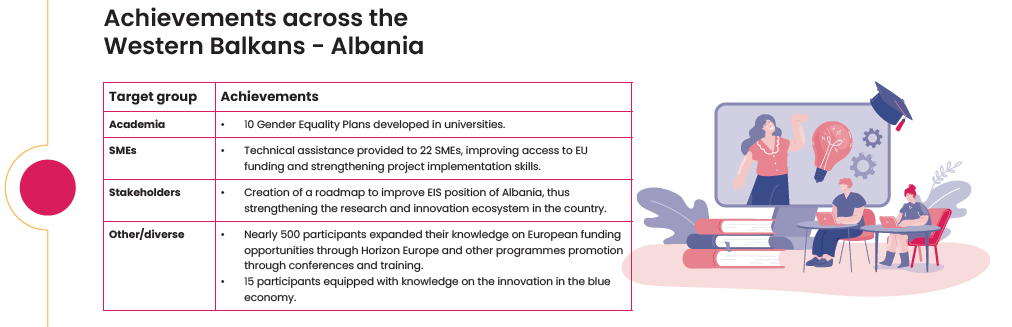
The POLICY ANSWERS partner NASRI is as national agency for research and innovation is in itself a main stakeholder in the Albanian ecosystem. For example, it is actively engaged in the monitoring and evaluation of the National Strategy for Scientific Research, Technology and Innovation 2023-2030. Across the project and in particular in the capacity building programme, stakeholder cooperation in Albania was broad-based, adaptive and increasingly institutionalised. NASRI acted as a central hub, connecting universities, ministries, municipalities, businesses, NGOs, and EU-level actors. Project activities addressed concrete needs, such as focus on eligibility for Horizon Europe, proposal readiness, participatory strategy development, and produced results that were actively taken up, institutionalised or embedded in ongoing policy processes. Structural changes were supported, notably in Horizon Europe preparedness (including GEP adoption) and S3 implementation, providing a solid foundation for sustained engagement with the European Research and Innovation ecosystem.
Capacity-building activities in Albania did not concentrate on a single beneficiary group, it deliberately addressed multiple layers of the research and innovation ecosystem, with actions designed to respond to concrete regulatory, strategic and operational bottlenecks identified through stakeholder consultations.
A defining feature was also the strong coupling between capacity building and EU integration requirements, in particular Albania’s full association to Horizon Europe, its integration into the European Research Area (ERA), and the ongoing development of the Smart Specialisation Strategy (S3). Stakeholder cooperation was therefore not only broad but also strategically targeted at actors whose engagement was essential for Albania’s progress in these processes.
Support for participation in Horizon Europe constituted a second major pillar of stakeholder cooperation. NASRI worked closely with its NCP network, universities, municipalities, NGOs, businesses, EU4Innovation (GIZ) and European Commission services to deliver a large and geographically inclusive programme of info days, training sessions and mentoring activities. Concrete highlights include the Horizon Europe Info Day in Albania (October 2023), which attracted over 110 participants from academia, SMEs and public authorities. More than 10 capacity-building sessions with universities were held across the country. Furthermore, a dozen dedicated and targeted mentoring and training events for municipalities were held, substantially expanding the circle of actors able to engage with EU funding opportunities. The inclusion of “unusual suspects” such as municipalities and NGOs marked a deliberate shift towards a more inclusive innovation ecosystem. A COST Info Day gathered 100 participants on site and over 40 other smaller promotional events, overall reaching more than 500 persons directly and more via further outreach activities. The promotional events and trainings contributed to the marked increase of Horizon Europe applications as well as submitted and signed grants: EU contribution rising from 3.98 million Euro in September 2023 to 6.94 million Euro in February 2025; number of Horizon Europe signed grants increased from 22 in September 2023 to 39 in February 2025. The exploitation of results is also visible in strengthened NCP capacities, increased institutional familiarity with Horizon Europe procedures, and a growing pipeline of prepared applicants. Multipliers were also enabled to participate in international meetings, enhancing Albania’s visibility and networking at European level.
Stakeholder cooperation with the private sector was addressed through a dedicated matchmaking and mentoring action for Albanian SMEs, focusing on programmes such as Eureka, Enterprise Europe Network, Horizon Europe, EIT, COST, and the EIC. Despite the allocation of national funds for Eureka calls, uptake by Albanian companies had been minimal prior to the project, largely due to low awareness and limited partner-search capacities. NASRI, in cooperation with chambers of commerce, SME associations and an external service provider, identified a group of approximately 10 innovation-oriented Albanian companies and provided them with targeted support. This included partner identification, mentoring on proposal quality and guidance on international evaluation criteria. A notable concrete activity was the training for grant assessors and companies held in Tirana on 26 September 2023. After the Eureka Network WB Call, further support was provided for companies to participate in the Western Balkans Innovation Vouchers. The main exploitation of results lies in the enhanced readiness of SMEs to engage in international innovation funding and in the establishment of matchmaking methodologies that NASRI can reuse in future funding cycles.
Another tangible highlight of stakeholder cooperation was the development of Gender Equality Plans (GEPs) for Albanian universities. At the outset of the project, Albania had very few documented GEPs nationwide, despite the fact that GEPs are an eligibility requirement for participation in large parts of Horizon Europe. POLICY ANSWERS experts assembled a consortium of higher education institutions committed to developing and implementing GEPs. The action combined strategic commitment (through signing of Memoranda of Cooperation) with practical capacity building, including workshops delivered online and on-site as well as one-to-one mentoring. By the end of the action, all participating institutions had approved and published their GEPs, moving also beyond mere compliance towards institutionally endorsed frameworks, strengthening internal governance capacities related to data collection, gender-sensitive policy design and organisational change.
A further highlight was Albania’s cooperation with stakeholders in the Entrepreneurial Discovery Process (EDP) for S3 implementation. POLICY ANSWERS engaged with stakeholders including, the Prime Minister’s Office, the EU Delegation and the Joint Research Centre (JRC) in organising and sustaining EDP workshops across the country. Eight sector-focused EDP events were successfully delivered between November 2022 and April 2023, covering areas such as agritourism, renewable energy, maritime tourism and forestry. By supporting logistics, facilitation and coordination, the project enabled meaningful engagement of academia, business and civil society in priority setting. The exploitation of results is evident in the completion of the EDP phase, the acceptance of outcomes by stakeholders, and the continuation of S3-related work under national leadership.
A focus was then also set on the blue economy as a priority sector. For the promotion of innovation opportunities in the blue economy, two workshops on innovation management were held in April and May 2023. They brought together stakeholders from fisheries, tourism, ports and related sectors. Finally, an Action Plan to Improve Albania’s European Innovation Scoreboard (EIS) ranking illustrates adaptive stakeholder cooperation. The result, developed by engaging with statistics institutes, ministries, and other institutions responsible for data collection is explicitly designed as an operational policy tool.
Last but not least, the final event of POLICY ANSWERS which took place in Tirana was an important avenue for stakeholder engagement. Representatives of the EC, the project partners, international organisations and networks, Albanian ministries, agencies, universities, businesses and other interested individuals engaged with the project outputs and each other. They also learned about the follow-up project and a study visit to the POLICY ENLARGE partner Berleti University completed the programme.