
 Search


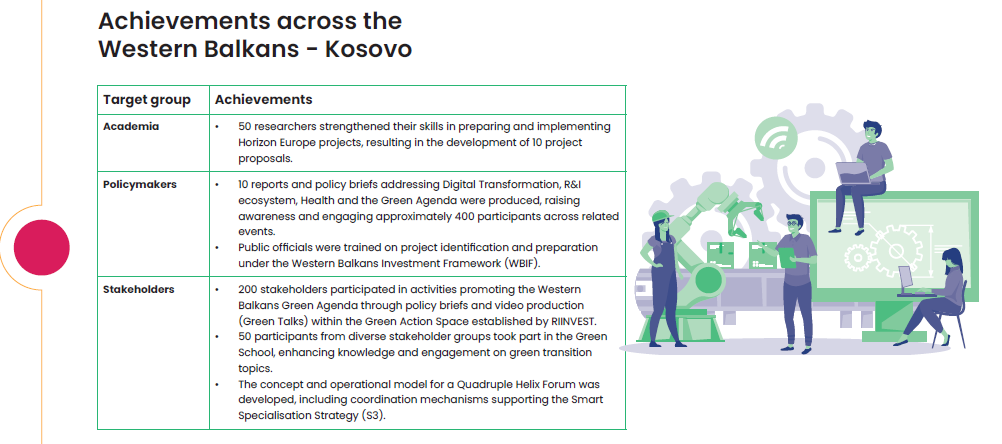
The capacity-building (CB) activities implemented in Kosovo within the POLICY ANSWERS project were designed and executed with a strong emphasis on stakeholder engagement for exploitation, rather than training as an end in itself. Across the 2022–2025 period, RIINVEST Institute operationalised a multi-layered stakeholder strategy that linked ministries, research organisations, universities, business associations, civil society actors and selected private-sector firms into concrete policy and implementation processes. This approach ensured that CB outputs were directly embedded into institutional practices, policy drafting and project pipelines, thereby maximising exploitation potential beyond the project lifecycle.
At the outset, RIINVEST conducted a structured identification of approximately 30 core stakeholders, spanning policy-making institutions, research and higher education organisations, business associations, innovation intermediaries and civil society.
Key public-sector stakeholders included the Ministry of Education, Science, Technology and Innovation, the Ministry of Industry, Entrepreneurship and Trade, the Ministry of Economy, the Ministry of Health and the Office of the Prime Minister. These institutions were not approached merely as beneficiaries of training, but as co-owners of analytical outputs, draft policies and coordination mechanisms. At the same time, universities (notably the University of Prishtina and regional public universities), the Academy of Sciences and Arts of Kosovo, and applied research organisations were targeted as multipliers for exploiting training results through project applications and internal capacity diffusion.
The ‘Stakeholders Forum’ established in Kosovo, composed by representatives of relevant ministries, academia, civil society and private sector businesses, follows the progress of POLICY ANSWERS’ activities twice a year. The Forum not only provided valuable inputs for creating synergies over priorities of the project and other activities at the RIINVEST institute and amongst stakeholders, but it is also the venue through which the POLICY ANSWERS project provides valuable inputs.
Concretely, advise was provided for the National Science Programme, on advancing participation of Kosovo in the European Research Area thorough better organisation of institutional structures, on the increase of financing for R&I and also for health financing and digitalisation. The Forum is kept informed and supports monitoring of the developments in particular related to the green and digital transition. The corresponding exploitation pathway of sustained technical assistance e.g. to the Kosovo Research Council and the Ministry of Education, Science, Technology and Innovation. Rather than substituting institutional responsibilities, RIINVEST engaged the actors in structured debates on funding levels, governance mechanisms and incentives for research based on surveys, analytical reports and policy papers. Evidence-based recommendations were formally submitted to government and parliamentary structures and systematically integrated into RIINVEST’s Annual Economic Forum analyses (2023–2025), thereby reaching a broader audience of policy makers, donors and private-sector actors. Media engagement, infographics and short videos further amplified exploitation by translating technical findings into accessible messages, increasing political and public pressure for reform in research financing and governance.
RIINVEST also worked closely with the Ministry of Industry, Entrepreneurship and Trade and its Kosovo Investment and Enterprise Support Agency to provide inputs into strategic documents and draft legislation, including discussions around the Innovation Fund. Business associations, innovation centres and selected firms were engaged in roundtables debating concrete policy options.
Although the formal establishment of a Quadruple Helix Forum was constrained by political instability, exploitation occurred through preparatory work and integration into related processes, such as the drafting of a Smart Specialisation Strategy.
In thematic areas such as the Green Agenda, digital transformation and health, exploitation was achieved through sustained interaction with line ministries and through the production of policy-relevant analytical outputs. In digitalisation, RIINVEST’s participation in working groups and preparation of progress reports ensured that the project’s outputs fed directly into national monitoring and strategy-design processes. In health, position papers and expert reports were exploited through stakeholder forums and advocacy, with early indications of improved budget allocation efficiency and increased pressure for digital health reforms. Technical assistance provided to energy and renewable-energy legislation was incorporated into final policy documents, while Green Talks and policy briefs served as platforms for continuous stakeholder engagement.
POLICY ANSWERS partner RIINVEST provided recommendations for the Ministry of Education, Science, Technology and Innovation, universities and the Agency for Accreditation on how to advance curricula contents and teaching methods and resources. These priority areas are relevant to the participation in regional and multilateral R&I activities at university level. Rather than delivering isolated workshops, RIINVEST conducted desk research and convened a roundtable with academic leadership and quality-assurance actors to assess how Green Agenda and digitalisation priorities were reflected in tertiary curricula. RIINVEST prepared and published a report on the state of the art, debated at round table in July 2024 with 30 representatives of universities, MESTI and other stakeholders. The faculties welcomed the report and expressed readiness to accelerate necessary changes in their curricula. Follow-up monitoring ensured that recommendations remained linked to accreditation and programme-review cycles, increasing the likelihood of durable change. Thus, advancing university curricula illustrates another exploitation channel.
Another flagship activity in Kosovo was the intensive training programme on Horizon Europe proposal preparation and project management, implemented in two cohorts in February and April–May 2023. Fifty researchers from universities and research organisations were selected through an open call and interviews that explicitly assessed their institutional positioning and potential to act as change agents. Participants were required to work on concrete project ideas during the training, leading to the identification and presentation of ten draft project proposals explicitly oriented towards Horizon Europe calls and ERA-related instruments by June 2023. RIINVEST also institutionalised follow-up mechanisms, including surveys and networking events, to track post-training application behaviour. The results demonstrate tangible exploitation recording several applications. Furthermore, trained researchers began providing informal mentoring within their faculties and research units, thereby multiplying the effect of the initial CB investment.
Exploitation in Kosovo was anchored in live policy processes, sustained engagement beyond single events and structured targeting of stakeholders and multipliers. While political instability and delayed government formation constrained some activities, the overall exploitation trajectory is robust. Outputs were used in policy drafting, project applications, advocacy and institutional learning processes, rather than remaining confined to project reporting. So, RIINVEST’s inputs contributed to shaping policies, bylaws and implementation discussions for innovation financing instruments. Evidence also indicates an increase in private-sector R&D investment, signalling early but concrete shifts in private-sector engagement with R&I.