
 Search


Internationalisation and stakeholder cooperation was supported by hosting several meetings of the Steering Platform in Skopje, but also constituted a significant part of the Capacity Building (CB) programme. Stakeholder engagement in North Macedonia included the organisation of two Steering Platform meetings 2023 and 2024 and a Ministerial event 2024. The high-level event held 29 September to 1 October 2024 gathered over 180 participants with ministers from all WB economies, reinforcing political commitment to the cooperation.
The POLICY ANSWERS CB programme in North Macedonia contributed also to structural learning within the innovation ecosystem, supporting both immediate implementation needs and longer-term reform trajectories. A combination of local ownership, expert input and international exposure provides a transferable model for other Western Balkan economies. The CB programme in North Macedonia focused on mainstreaming priority themes such as the digital transformation and green transition but also professional innovation management and evidence-based policymaking, into the daily work of public institutions, innovation intermediaries and firms. The involvement of both MIR Foundation and INOVA (FITD’s successor) as local partners ensured that activities were embedded within different stakeholder groups and policy processes.
POLICY ANSWERS created a team of contact persons within relevant institutions that each year supports the monitoring progress of the WB Agenda and from 2025 also of the New Growth Plan. This involves representatives from the following public institutions: Ministry of Education and Science, Ministry of Economy and Labour, Ministry of Culture, State Office of Industrial Property, former Agency for Youth and Sports (later Ministry of Sport), Ministry of Environment and Physical Planning, Ministry of Energy, Mining and Mineral Resources and the Agency for the Support of Entrepreneurship (later merged with FITD to form INOVA). It also involved representatives from Digital Innovation Hubs, Enterprise Europe Network, Erasmus for Young Entrepreneurs and the EIT Regional Innovation Hub. This not only facilitated the monitoring process, but also secured increased awareness about the project and progress achieved in regard to the WB Agenda. The networks were built from the project start and strengthened during a study visit to Brussels and trainings on monitoring and evaluation of public policy in 2023.
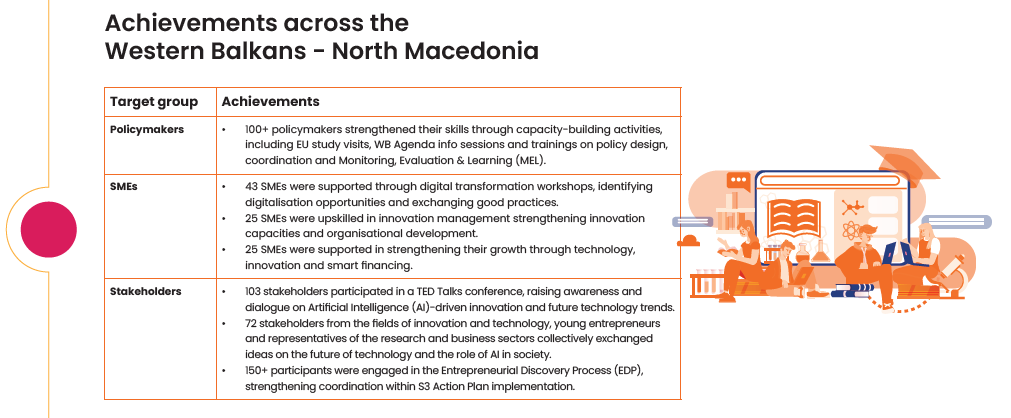
The training programme on policy design, coordination, monitoring and evaluation stands out as one of the cornerstones of the programme with high-level political buy-in. The info session and Q&A on the WB Agenda, which provided direct access to European Commission officials for discussion of implementation challenges, clarified interlinkages between the WB Agenda, the green transition and digital transformation. Subsequent online trainings on policy design and coordination (April 2023) and on monitoring, evaluation and learning (May 2023) translated these strategic insights into operational tools. Participants worked on sector-specific examples drawn from their daily responsibilities in research, education, culture and youth policy. Feedback indicates that these trainings were particularly valued for enabling participants to apply indicator logic and evaluation frameworks to ongoing policy documents, rather than treating M&E as a formal afterthought.
A dedicated study-visit to EU institutions in Brussels (April 2023) represented another critical moment of result exploitation. Timed to precede the bilateral meeting for Chapter 25, the visit involved 12 senior officials from ministries, INOVA/FITD, the Secretariat for European Affairs and the Prime Minister’s Cabinet. Meetings with various DGs provided concrete insights into how innovation, education and youth policies are coordinated at EU level. Participants explicitly linked these insights to their preparation for accession-related discussions, demonstrating direct policy relevance of the project’s activities.
Beyond EU-level engagement in Brussels, MIR Foundation participated in multiple international conferences and peer-learning study visits, including the UK, Belgium, Spain and Germany. These activities were not isolated dissemination exercises but were systematically used to import good practicesand expand professional networks. For example, the UK peer-learning study visit (February 2025) provided insights into innovation and sustainability policies through meetings with UKRI, NESTA, ARIA, Oxford-based innovation actors and participation in the Source Fashion Fair. Participants identified transferable practices, particularly in relation to ecosystem governance and support for sustainable innovation. Participation in the STE(A)M ATLAS conference in Brussels (July 2025) and subsequent engagements in Seville and Munich further strengthened MIR’s role as an intermediary between Macedonian and European innovation communities. Project results were presented and opportunities for future collaboration identified, contributing to the international visibility and credibility of stakeholders from North Macedonia.
Support for S3 implementation represents another very significant long-term impact of the CB programme. Through a series of workshops and mentoring activities in 2025, over 150 stakeholders from the quadruple helix were engaged in refining the S3 Action Plan for 2026–2027. Interactive methodologies ensured that discussions resulted in concrete policy proposals, including improved monitoring systems, refined innovation vouchers and enhanced doctoral schemes. The transition from FITD to INOVA necessitated adjustments in delivery formats but ultimately strengthened institutional ownership. INOVA / FITD also allocated resources towards ecosystem-level support and S3 implementation. Participation in the EIT Summit in Brussels (May 2025) enabled alignment of local support measures with EIT and EIC instruments. The transition from FITD to INOVA and the securing of funding under the IPA Greening Business Facility represent a tangible exploitation of project insights, embedding CB outcomes within a stable institutional and financial framework.
CB activities targeting the business sector were designed in response to persistent structural weaknesses identified by stakeholders: limited innovation management capacity, insufficient digital maturity and constrained access to finance. Rather than addressing SMEs as a homogeneous group, activities differentiated between product-oriented firms, service-oriented firms and scale-ups, allowing for tailored content and delivery.
For example, the digital transformation workshops, held in November 2025 in Skopje which reached 43 SME representatives, combined conceptual frameworks (digital maturity, transformation roadmaps) with practical diagnostics, enabling firms to identify internal bottlenecks and prioritise investments. Participants included managers and digitalisation leads, ensuring that learning translated into decision-making rather than remaining at operational level only. Similarly, the innovation management workshops (December 2025) addressed a recognised gap in structured innovation processes within SMEs. By introducing tools for idea generation, evaluation and implementation, the workshops enabled firms to formalise innovation activities that were previously ad-hoc. Stakeholder feedback indicates that participants valued the opportunity to benchmark practices across sectors, fostering peer learning in addition to expert input. Another highlight was the ‘ScaleUp Bootcamp’ 2025, which moved beyond training into mentoring and pitching. With 25 participants, the bootcamp provided scale-ups with concrete guidance on financing options, investment readiness and growth strategies.
At ecosystem level, the action on peer learning and exchange of best practices for technology transfer, innovation and twin transition had a clear multiplier effect. The ‘TvinTek Connect’ conference, held in Skopje in May 2025, brought together over 100 participants from academia, industry, policy and innovation support organisations. Unlike traditional conferences, the event explicitly aimed to strengthen links between research and industry, with sessions designed to facilitate networking and collaboration. The event created a neutral convening platform, enabling dialogue across institutional silos. Participants reported that the conference filled a gap in the national innovation ecosystem (NIS) by providing visibility to technology transfer practices and by stimulating partnerships that extend beyond individual projects. Furthermore, the ‘TvinTek TALK’ event in June 2025 further broadened engagement by addressing Artificial Intelligence and creativity, attracting 72 participants from diverse backgrounds. While less policy-oriented, the event contributed to raising awareness of AI-related opportunities and challenges, supporting the long-term objective of supporting digital transformation.