
 Search


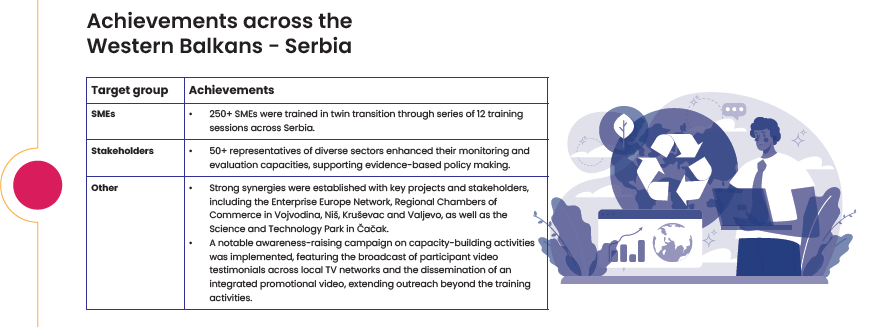
Over the course of the POLICY ANSWERS project, the Institute Mihajlo Pupin (IMP) established and progressively consolidated a broad, multi-layered stakeholder network, reflecting a deliberate strategy to connect policy, implementation and beneficiary levels within Serbia’s research, innovation and business ecosystem. IMP demonstrated continuity of engagement as well as gradual expansion and diversification of contacts, moving from core national institutions towards regional and thematic actors. The depth and continuity of cooperation with core institutional stakeholders at various levels was highly important.
At the policy level, IMP maintained stable and repeated interaction with key line ministries, most notably those responsible for economy, education, science, innovation, environmental protection and European integration. For example, as part of the consultative process designing the Capacity Building (CB) programme for Serbia, several meetings were held with policymakers from ministries responsible for science and technological development and economy. However, the interactions were not limited to ad-hoc consultations at the beginning but evolved into sustained working relationships. Engagement typically involved both senior and mid-level civil servants, which allowed IMP to translate strategic policy priorities into operationally relevant capacity-building actions and, conversely, to feed evidence from implementation back into policy discussions (for example on smart specialisation and evaluation practices).
At the implementation and intermediary level, partnerships were strengthened with chambers of commerce, development agencies, science and technology parks, regional innovation centres and business support organisations. These actors played a dual role: they acted as multipliers for outreach to SMEs and regional stakeholders, and they functioned as co-organisers and hosts of capacity-building activities. Examples include the Chamber of Commerce and Industry of Serbia, Science and Technology Park Novi Sad, European House Niš, Business Innovation Centre from Kragujevac and Regional Development Agency for spatial and Economic development of Raski and Moravicki Districts. Over time, several of these relationships became institutionalised, with partners repeatedly involved across different actions (digital transformation, green transition, monitoring and evaluation), signalling trust and mutual benefit rather than one-off collaboration.
At the beneficiary and practice level, IMP’s stakeholder relations encompassed SMEs, clusters, business associations, start-ups, consultants and individual experts with widening sectoral and geographical spread over time, aligning with the project’s priorities towards stronger regional coverage and more practice-oriented formats focusing on co-creation and applied learning, as reflected in advanced workshops and trainings that required active input from participants.
The digital transformation actions for SMEs illustrate concrete usefulness and exploitation: Six workshops (basic and advanced) reached 138 SME representatives across multiple regions, deliberately reducing regional disparities. The involvement of the Chamber of Commerce, the Centre for Digitalisation and the Enterprise Europe Network (EEN) enabled immediate follow-up: A particularly tangible outcome was the matchmaking event organised in parallel with the Belgrade workshop in 2023, jointly with the Enterprise Europe Network (EEN) Serbia, which brought together SMEs seeking digital solutions and domestic IT providers. This event moved beyond training into direct business–technology interaction. Importantly, training formats were adjusted in response to participant feedback (shortened to one day), demonstrating adaptive implementation. Furthermore, the results were exploited structurally: digital transformation training has since been embedded into the regular service portfolio of EEN Serbia and the Chamber’s Education Centre, ensuring continuity beyond the project.
The green transition activities provide another strong example of stakeholder-driven adaptation and result exploitation. Initial introductory workshops revealed high demand and low baseline awareness among SMEs, particularly regarding concrete regulatory implications such as the Carbon Border Adjustment Mechanism (CBAM). As a result, the project expanded and deepened the green transition action, replacing proposal-writing workshops with advanced, practice-oriented green transition training. These advanced workshops required participants to develop tailored digital roadmaps for greening their businesses, moving from awareness-raising to applied planning. The exploitation of results is tangible: green transition training has become a core topic within EEN Serbia and is being further reinforced through IMP’s involvement in the Interreg “Carousel” project on upcycling, directly linking CB outputs to new funding streams and initiatives. Another concrete institutional outcome of the cooperation with stakeholders on the capacity building was the signing of a Memorandum of Understanding with the Chamber of Commerce of Vojvodina, which laid the groundwork for continued joint activities beyond the project.
A majority of participants in the capacity-building events on the twin transition were female company owners, largely thanks to the dissemination of calls for participation through the network of the Association of Business Women in Serbia, which also supported the development of the Western Balkans Regional Innovation Academy by sharing available materials. Furthermore, the Association implements its own training programmes for women-led companies as part of its regular educational offer. Together with the Chamber of Commerce and Industry of Serbia, the association is expected to act, at least to some extent, as sustainability pillar, depending on future additional funding.
A particularly policy-relevant highlight is the training on programme evaluation and evaluation practices, which addressed a structurally weak area in Serbia’s STI governance. Unlike SME-focused actions, these workshops targeted civil servants from the Ministry of Economy and the Ministry of Education, Science and Technological Development, programme owners from the Innovation Fund and Science Fund, researchers, evaluators and innovative SMEs simultaneously, fostering a shared understanding of evaluation logic across roles. The cooperation with Science and Technology Parks, EU House Niš and regional innovation centres ensured access to local policy actors rather than concentrating participation in Belgrade. IMP implemented five workshops on monitoring and evaluation across five cities in Serbia, targeting not only the research community but also representatives of relevant ministries and other local stakeholders. These workshops have directly supported the capacity of stakeholders to engage in evidence-based policy making, thereby reinforcing IMP’s role in shaping research and innovation strategies at both national and regional levels. Stakeholders explicitly used these trainings to strengthen evidence-based policy discussions around STI programmes and Smart Specialisation Strategy (S3) implementation. The results are being exploited mainly at policy level: insights and methodologies are fed into ongoing S3 preparation and Entrepreneurial Discovery Process discussions, strengthening policy dialogue and reinforcing reflection and institutional learning within ministries and funding bodies.
Across all actions, experts were not used as generic trainers but as embedded knowledge brokers, adapting content to Serbian regulatory, economic and institutional realities. This was reflected in consistently high usefulness scores for daily work (above 4.3 out of maximum 5 across actions).
A notable feature of IMP’s stakeholder relations is their adaptive character based on strategic adjustments in the work programme: as certain needs diminished (e.g. proposal writing), engagement shifted towards stakeholders relevant for emerging priorities (green transition, evaluation capacity, regional innovation ecosystems). The regional spread of workshops was also a deliberate response to stakeholder feedback and aimed at reducing territorial disparities in access to specific expertise. This signals how stakeholder management was used as an analytical tool, not merely an administrative requirement.
The stakeholder relations developed by POLICY ANSWERS in Serbia through IMP can be characterised as dense, cross-sectoral and cumulative. Rather than expanding the network indiscriminately, IMP deepened cooperation with selected core actors while selectively broadening its reach to new categories of stakeholders as project priorities evolved. This approach strengthened IMP’s role as a credible intermediary between policy makers, support organisations and end users, and created a stakeholder base capable of sustaining and exploiting project results beyond the formal lifetime of POLICY ANSWERS.
One of the project’s strongest impact lies in the systemic uptake and institutionalisation of results: three of the four actions are already integrated into existing structures (EEN, Chamber of Commerce training programmes, regional innovation ecosystems), moving beyond isolated training events towards integrated activities and into permanent services. Stakeholders actively reused content, leveraging project results to reshape delivery formats and contents.
The robust engagement of various Serbian communities in the project activities are also demonstrated through the high participation of actors in the pilot schemes, in particular the Western Balkans Innovation Vouchers as well as the Mobility Scheme where they were most active in hosting grantees.
Furthermore, IMP actively contributed to international and regional peer-learning events and conferences such as the ‘Opportunities Week’ in September 2024 in Belgrade, an event series focused on EU programmes and opportunities for a mixed audience of companies, research organisations and institutional actors. This opportunity was used to introduce the capacity building possibilities as well as the Western Balkans Innovation Vouchers. Another opportunity to promote these possibilities was the conference ‘Enabling Progress: Industry 4.0 in the Western Balkans’ organised by UNIDO in collaboration with the Faculty of Technical Sciences in Novi Sad, held in June 2024. During the event, the two pilot schemes were promoted to the research community and innovative companies, including the tenants of the S&T Park Novi Sad.
Through the fellowship programme, IMP also established connections with the network of ‘Austrian Cooperative Research’, with the idea of replicating or adapting a similar model of bringing together the research community and, in cooperation with local stakeholders, organising events based on in-kind contributions or by securing additional funding in the future.