
 Search


Launched in early 2024, the POLICY ANSWERS Webinar Series opened with regional experts Bojana Bajic, Marija Jevtic, and Djorđe Djatkov, who provided an overview of the Western Balkans’ progress in implementing the Digital Agenda, shaping modern Health Policy, and advancing the Green Agenda. As authors of Policy Briefs and Reports, they highlighted key challenges, best practices, and strategic recommendations for the region.
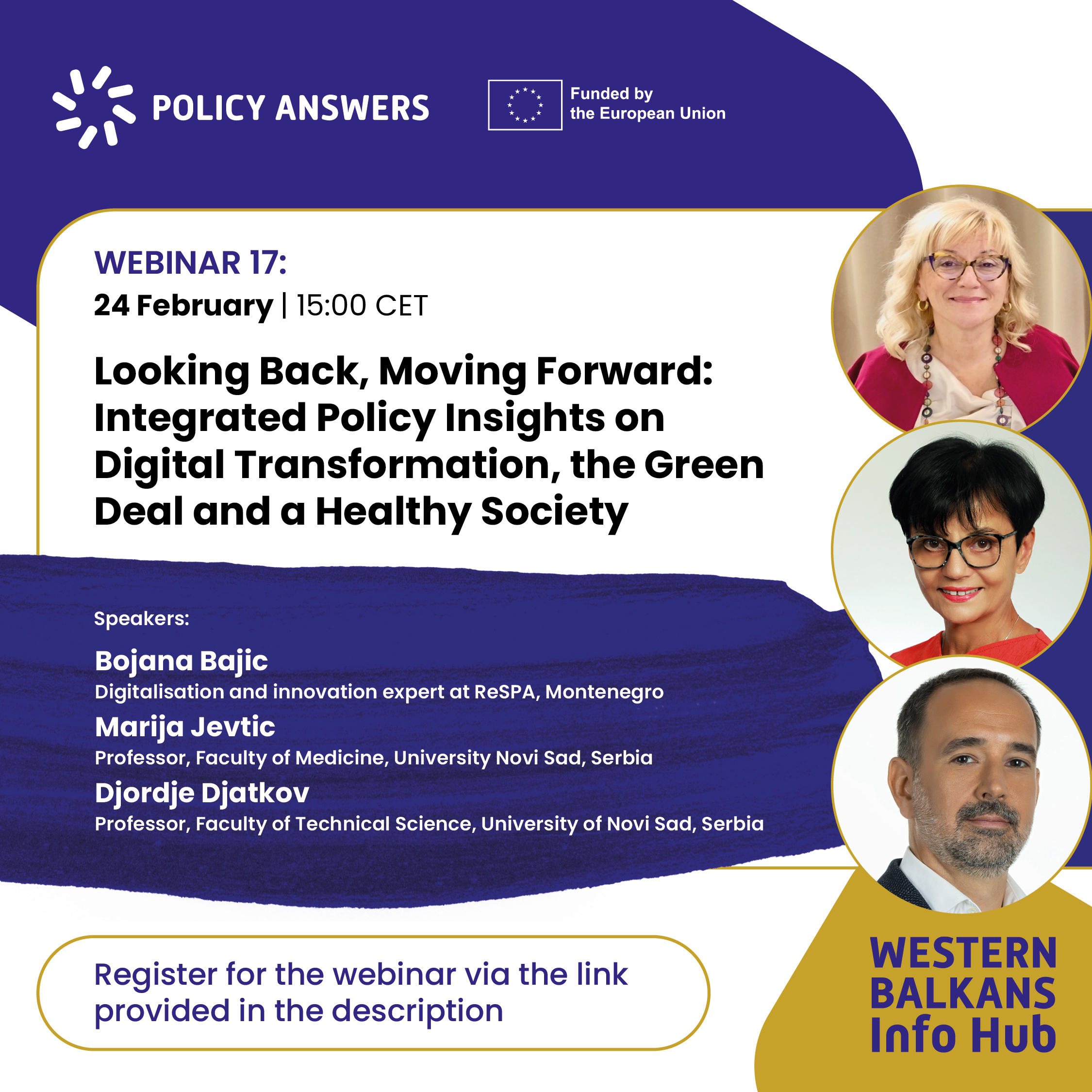
Two years later, this final POLICY ANSWERS Webinar — Looking Back, Moving Forward: Integrated Policy Insights on Digital Transformation, Health and the Green Deal — revisited those insights to assess progress made, remaining gaps, and future priorities.
With this session, which took place on 24 February, 15:00 CET, the POLICY ANSWERS Webinar Series is concluded.
Speakers:
Bojana Bajic, Digitalisation and innovation expert at ReSPA, Montenegro
Marija Jevtic, Professor, Faculty of Medicine, University Novi Sad, Serbia
Djordje Djatkov, Professor, Faculty of Technical Science, University of Novi Sad, Serbia
The webinar “Looking Back, Moving Forward: Integrated Policy Insights on Digital Transformation, Health and the Green Deal” took stock of developments over the past two years in digital transformation, the Green Deal and health policy in the Western Balkans and formulated key recommendations for the years ahead. The discussion built on a series launched in 2024 that attracted several hundred participants and, through the Western Balkans Info Hub and YouTube, continues to reach a wider audience.
In the Green Deal segment, Djordje Djatkov presented the Green Agenda for the Western Balkans as a policy framework that has been progressively specified through the Sofia Declaration of 2020, the Hamburg Declaration of 2024 and a revised action plan in 2025. He underlined that, while the region has made visible progress in developing framework conditions, particularly for decarbonisation, energy, transport and climate policy, implementation in practice lags significantly behind the stated ambitions. At the same time, the green transition was described as a major economic opportunity, for instance through new industries, job creation and a more developed bioeconomy, which so far is only sporadically supported by strategic concepts and concrete measures. Education and capacity building were highlighted as key levers to address governance deficits, low public awareness and the limited eligibility of Western Balkan economies for instruments such as Just Transition funding.
Marija Jevtic’s contribution on health policy stressed the close interlinkages between environment, digitalisation and health, drawing on concepts such as population health, One Health and planetary health. The Western Balkans are particularly vulnerable to climate change and environmental pollution, while health systems are often fragmented, understaffed and characterised by parallel public and private structures. She emphasised that the health sector accounts for a notable share of global CO₂ emissions and that sustainability therefore needs to become an integral part of planning and steering health services. Digital technologies and Artificial Intelligence were presented as offering significant potential for prevention and early diagnosis, but they require clear ethical frameworks, training of health professionals and efforts to strengthen health literacy and trust in institutions. Two contrasting future scenarios can be perceived: A negative scenario would see growing inequalities, continued reform deadlock and rising instability, whereas a positive scenario would involve stronger primary care, “green” hospitals, targeted use of AI and a cultural shift towards prevention. Policy recommendations include more consistent policy implementation, stronger emphasis on empathy and personal communication in healthcare, and systematic cooperation between health, environment and digital policy. Education and continuous professional development in the health sector were portrayed as crucial to move from a reactive, treatment‑focused approach towards a proactive understanding of health promotion.
Bojana Bajicstructured the discussion on digital transformation around the EU’s “Digital Compass 2030”, connectivity, digital skills, digitalisation of business and digital public services. She showed that Western Balkan economies have made notable progress in recent years in expanding broadband and 5G, improving basic digital skills and rolling out digital public services; Albania, for example, now offers the vast majority of its public services online. New institutions such as ministries for digitalisation and cybersecurity agencies, established are additional positive drivers. At the same time, she identified persistent shortcomings in the interoperability of administrative and data systems, which hampers the consistent application of the “once‑only” principle and the re‑use of data. A digital divide between the public and private sectors remains, shaped by unequal investment capacities, limited AI readiness and the absence of comprehensive ethical frameworks. She stressed that cybersecurity is a basic precondition for all further digitalisation efforts and that public–private partnerships are needed to mobilise investment and innovation. Her recommendations included stronger central coordination and governance, systematic monitoring and evaluation of digital initiatives, and the development and implementation of clear AI strategies and standards.
The discussion also addressed cross‑cutting linkages and open questions. Overall, the webinar underlined that sustainable development in the Western Balkans will only succeed if the Green Deal, health policy and digital transformation are conceived and implemented in an integrated way at political, institutional and societal level.