
 Search


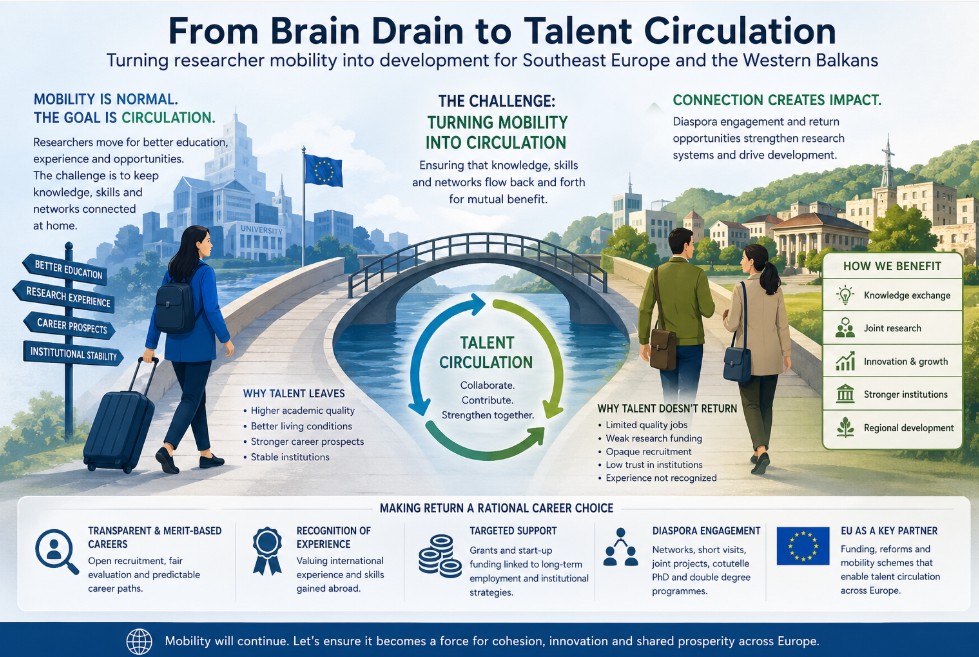
For years, talent mobility in Southeast Europe and the Western Balkans has been viewed mainly as brain drain. However, a recent Science|Business viewpoint argues that this narrative is outdated, as mobility is now a normal and necessary part of academic careers rather than an exception.
Today, students and researchers increasingly move across borders for education and career development. This mobility is driven by better academic quality, stable institutions, and stronger job prospects abroad. Crucially, decisions to stay abroad are shaped less by education itself and more by access to reliable employment and career pathways.
Rather than trying to stop this movement, experts suggest focusing on “talent circulation” — ensuring that knowledge, skills, and networks flow back to home countries. Mobility is a rational response to structural differences between national systems, not a sign of disloyalty.
A key challenge remains the lack of return incentives. Researchers often face weak job markets, limited funding, and opaque recruitment processes at home. As a result, returning can be risky for their careers. Still, many in the diaspora remain connected through research collaborations and academic networks, highlighting untapped potential for stronger engagement.
The article emphasizes that policies should shift toward making return a viable and attractive option. This includes transparent hiring, merit-based careers, and recognition of international experience. Financial incentives, such as grants, can help — but only if combined with broader institutional reforms.
The European Union also has an important role to play. By aligning funding, reforms, and mobility schemes, the EU can support a system where talent moves freely while still contributing to regional development. This would transform mobility from a perceived loss into a shared European asset.
Ultimately, the debate is no longer about stopping brain drain, but about managing mobility more effectively. If properly governed, talent circulation can strengthen research systems, reduce regional disparities, and support long-term development across Europe.
Original article: Read the full viewpoint on Science|Business