
 Search


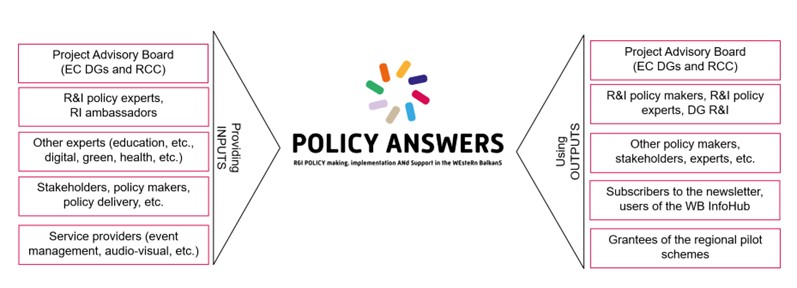
Engagement with the recipients of POLICY ANSWERS outputs is central to ensuring that the project’s results are understood, taken up and used in practice. The project cooperates closely with its primary users, including the Project Advisory Board, the wider community of R&I policy makers and policy experts, as well as other policy makers and stakeholders active in areas such as education, culture, youth, sport, the Green Agenda, digitalisation and health. Outputs are made accessible through multiple channels, most notably the Western Balkans Info Hub, the project newsletter and direct communication via regional contact points.
Building on the target groups defined in the project’s Dissemination, Communication and Exploitation Plan, the project deploys tailored formats to match the information needs and roles of different stakeholder communities. The overall dissemination architecture and key performance indicators are reported in detail in the relevant work package reports. In this chapter, a selection of concrete cooperation examples is presented in order to showcase effective practices of stakeholder engagement and exploitation of results; these examples are illustrative rather than exhaustive and are intended to highlight the diversity and depth of interactions achieved throughout the project.
Focus was placed on different stakeholders and stakeholder groups. In the post below, you find more information about the cooperation with specific target groups below:
- European Commission bodies, DG Research and Innovation and other services
- Regional Cooperation Council
- Academia and universities
- Businesses, Enterprise Europe Network, Chambers of Commerce, etc.
- Governments, agencies, programme owners
- Intermediaries and integrators, National Contact Points, etc.
- Civil society, think tanks, NGOs, stakeholders in development aid cooperation, etc.
- Other projects, new projects and proposals
- Media
European Commission bodies, DG Research and Innovation and other services
The project’s policy dialogue activities have been organised in cooperation with and for three successive Commissioners responsible for R&I and their cabinets, with a focus on ensuring that POLICY ANSWERS contributed to and was aligned with the evolving EU R&I policy agenda. In 2022, an event was held in Tirana under the mandate of Commissioner Mariya Gabriel. In 2023, a meeting planned in Skopje was postponed to 2024 following her departure from office on 15 May 2023. In 2024, an event took place in Skopje under the mandate of Commissioner Iliana Ivanova. And in 2025, Commissioner Ekaterina Zaharieva met with the ministers of the region in Podgorica. Discussions addressed issues such as Horizon Europe implementation, integration in different dimensions of the European Research Area and the preparation of future programmes, as well as topics such as Smart Specialisation Strategies or Artificial Intelligence, where the Commissioners and their cabinets sought stakeholder input on the regional innovation ecosystems. Further topics were widening measures, to which POLICY ANSWERS could contribute through the organisation of policy dialogue meetings, networking opportunities, analytical evidence and Policy Briefs.
The key exploitation partner for POLICY ANSWERS was the European Commission’s Directorate-General for Research and Innovation, which the project supported by delivering timely Policy Briefs, structured networking opportunities and targeted analytical inputs on R&I in the WB. These briefs, for example the dedicated analysis on the development of the future Framework Programme (FP10) or the development of Research Infrastructures in the Western Balkans, have been presented and discussed with the responsible Policy Officers and their hierarchy, who plays a central role in conveying regional evidence and stakeholder perspectives into internal reflections on programme design and implementation. Through briefing meetings, participation in policy dialogues and facilitation of contacts with regional stakeholders, the project has supported DG R&I with up-to-date insights and ideas on the links between EU-level initiatives and the needs and capacities of the enlargement countries. Close interaction with DG R&I services was for example realised in relation to the ERA reports (WP2, Task 2.3), where POLICY ANSWERS was able to adapt to the changing contractual environment and exploit synergies relating to the division of labour between POLICY ANSWERS and the contractors for ERA monitoring. For example, in the second iteration, the contractor for ERA monitoring was responsible for Serbia and Montenegro, and POLICY ANSWERS could consolidate the overview in a Policy Brief.
As part of these advisory structures, POLICY ANSWERS has also provided forward-looking analytical support through dedicated foresight activities. Our foresight work exploited previous work and also found continuation in an activity under the framework of the “Global Service Facility” in regard to the enlargement countries (implementation started end of 2025 and is ongoing during 2026). The renewed momentum for EU enlargement has created a need for anticipatory policy support, for which foresight is used to explore key drivers, alternative futures and related policy options for R&I systems in candidate countries. The new initiative goes beyond the Western Balkans and includes in total ten economies for which it maps trends and drivers, builds contrasting R&I scenarios, derives country-level policy recommendations, provides a cross-regional comparison of challenges and support options, and synthesises and disseminates the results in accessible formats during 2026. Close interaction is planned with the POLICY ENLARGE follow-up project also focusing on the broader enlargement region.
During the implementation of POLICY ANSWERS, participation by project partners in Joint Committee meetings was enabled. Furthermore, interactions with cooperation partners such as Eurostat took place, on the issue of statistics and the European Innovation Scoreboard, for which a webinar was supported by the project and a dedicated follow-up activity planned under the Albanian Capacity Building Programme.
As the Project Advisory Board (PAB) of POLICY ANSWERS brings together “ex officio” representatives from key EC services responsible for the WB under the leadership of DG Research and Innovation, close relations for inputs but also exploitations were enabled with DG Education and Culture, the Joint Research Centre, DG GROW and DG ENEST (former DG NEAR), DG AGRI, DG CNECT, DG REGIO, EEAS (EU Delegations), EISMEA, etc: The PAB received the project’s outputs linking the work with broader regional cooperation efforts of the European Commission. Within this framework, there was particularly close interaction with DG EAC and DG JRC, which used POLICY ANSWERS’ “Policy Dialogue” Work Package in planning and implementing related Steering Platform and Ministerial Meetings and discussions focused on Education and Training, Culture and Smart Specialisation, where the respective policy officers cooperated on agenda setting, alignment with EU initiatives and follow-up on outcomes.
The JRC for example concluded an agreement with North Macedonia relating to S3 and POLICY ANSWERS fed into the activities through targeted capacity building activities.
Several points of cooperation also included the European Institute of Innovation and Technology (EIT), which, e.g., used our events to promote its activities. The cooperation of and with the EC was beneficial for wider impacts including strengthened cooperation with programmes such as Interreg ADRION, networks such as ScienceBusiness and UNICA, initiatives related to research infrastructures such as NANOBALKANS, BIOSENSE, etc. In this context, POLICY ANSWERS expertise was for example also used by the EC (and the European Investment Bank) cooperating with JASPERS (Joint Assistance to Support Projects in European Regions) assessing the planned Bio4Campus in Serbia.
Regional Cooperation Council (RCC)
Cooperation with the RCC was active from the preparation of the proposal until the final event. A representative of the RCC is member of the POLICY ANSWERS Advisory Board, providing feedback on activities and priorities as well as on policy messages. Regular interaction with the RCC takes place through the Policy Dialogue activities in the “Policy Dialogue” Work Package, where representatives are always invited and dedicated side events are co-organised.
In turn, POLICY ANSWERS contributed to the RCC’s online exchange format “Innovation and Research Platform”, which took place at irregular intervals, through targeted presentations by the coordinator ZSI or for example, in the context of the RCC-funded knowledge transfer project on financial instruments promoting innovation, through inputs presented by INOVA in autumn 2025. The project also engaged in targeted exchange with the RCC on the Butterfly Innovation Awards, which were frequently promoted via the WB Info Hub as well as RCC publications and events. In turn, the project’s pilot calls were promoted on the RCC’s Balkaninnovation.com webpage, resulting in shared visibility and reinforcing the outreach of both initiatives.
The POLICY ANSWERS partner DLR also cooperates closely with the RCC providing various studies which fed into each other. For example, the results of POLICY ANSWERS Task 2.4 – as well as the European Commission’s 2021 Strategic Foresight Report – fed into the RCC study “Unleashing the Potential for Competitiveness: Trends in the Western Balkans”. The study, prepared by DLR on behalf of the RCC, presents trends likely to shape the region’s competitiveness up to 2035, examines the potential impact on inclusive growth and offers possible implications of the trends that could be useful for the WB.
Cooperation with academia and universities
The academia stakeholder group (universities, research performing organisations, researchers, etc.) constituted the largest and most consistently engaged audience of the project. It was well covered through the project website and the WB Info Hub, and academic communities from the region, including diaspora actors, also followed the project via social media channels. Participation of research organisations and universities in the consortium itself was of great importance and impact, reinforcing the project’s role as a regional hub for cross-border information exchange and collaboration. Academic stakeholders were actively involved through research-focused workshops, webinars, consultations and contributions to analytical outputs and policy discussions. The project offered relevant platforms for knowledge exchange and evidence-based input, and feedback from academic stakeholders was explicitly taken into account in the development of reports and policy recommendations, particularly where methodological or conceptual expertise was required. Academic stakeholders, reflecting the fact that existing contact networks of the consortium were strongest in this sector, were regularly engaged and informed, and their feedback contributed to both methodological and content-related improvements. Consequently, academia can be highlighted as the stakeholder group that probably benefited most from the project.
POLICY ANSWERS contributed to institutional change in universities across the WB and cooperation with academia by combining a) targeted capacity building, b) strengthened collaboration with other stakeholders along the quadruple helix through the systematic involvement of academic experts and networks such as rectors’ fora, and c) support for the career development of young researchers in the region via the Western Balkans Mobility Scheme and other pilots.
The University of Sarajevo (UNSA) and the University of Banja Luka (UNIBL) played a central role in capacity building activities that targeted both their own academic communities and a broader set of national stakeholders. As partners responsible for Bosnia and Herzegovina, they organised and hosted training workshops on topics such as Horizon Europe participation, proposal development, project management and innovation-related skills, librarian services in the era of open science, thereby strengthening internal support structures and enhancing the competencies of researchers, administrative staff and external participants from business and public institutions. For example, with the aim of boosting collaboration between university member institutions, students and industry representatives, UNSA supported the scientific and research incubator SCI.HUB in Bosnia and Herzegovina, which was opened on 20 December 2024, by providing support on project management and administration. Furthermore, POLICY ANSWERS activities helped researchers of Faculty of Science through targeted consultations on proposal development, which directly contributed to their successful acquisition of a Horizon Europe coordinating grant. In parallel, UNSA organised an institutional IPR Day in cooperation with researchers from the Faculty of Law, jointly promoting intellectual property management and valorisation practices across more than 15 faculties and research institutes. These activities strengthened interdisciplinary cooperation, raised institutional awareness of IPR and reinforced universities’ capacity to translate research results into societal and economic impact. In line with these capacity-building efforts, the Faculty of Philosophy at the University of Banja Luka (UNIBL) hosted a two-day event titled ‘Open Science and Intellectual Property Protection’ on 24 and 25 October 2024. The programme featured a high-level panel discussion on the balance between open research and market protection, alongside specialized training on identifying the licensing potential of scientific discoveries, and the practical application of open science principles and IP valorisation. By opening these sessions to a diverse range of stakeholders from the industrial and governmental sectors, UNIBL acted as a central node in the Quadruple Helix, inviting to a more direct exchange of knowledge and resources between academia and external partners to drive regional economic development. Building on POLICY ANSWERS activities, further project applications were launched. For example, a study visit to the University of Split and meetings with representatives of the Technology Park of the University of Split (SPINIT) and the Mediterranean Institute for Life Research (MEDILS), organised by UNSA, resulted in a joint COST Action proposal involving MEDILS and INGEB, the UNSA Institute of Genetic Engineering and Biotechnology, while UNIBL successfully submitted several applications to Horizon Europe based on trainings and consultancy provided through the POLICY ANSWERS capacity building programme. UNIBL also improved its research management through cooperation with the “V4+WB Network of Research Managers and Administrators Plus” and the “BEAMING” projects and trainings on commercialisation, licensing and patenting by university researchers or on the application of open science principles.
Beyond the immediate impact on the universities directly involved as partners, universities and academia more broadly were core target groups of several project activities. POLICY ANSWERS mobilised academic experts to contribute to foresight exercises, ERA reporting and thematic policy work (digital, green, health), and university leadership and research support units took part in workshops, advisory activities, policy dialogue formats and pilot actions. An initiative with direct institutional impact was launched in Albania, where capacity building activities enabled eight universities to publish their Gender Equality Plans (GEPs) in 2023; further training offers, for example on innovation management in the blue economy or participation in Horizon Europe, encouraged academic staff and young researchers to regard applied research and international cooperation as core elements of their work rather than peripheral activities.
RIINVEST engaged in cooperation with universities and university colleges in Kosovo for advancing curricula with the contents related to priority topics related to R&I, green transition and digital transformation. Following a report on the state of play, including case studies about advanced experiences dissemination and advocacy, the partner evidenced impact in several higher education institutions (HEIs), such as the University of Applied Sciences in Ferizaj, the Faculty of Economics and the Faculty of Natural Sciences of the University of Pristina, as well as the Universum International College and the UBT College in Pristina. In addition to these outputs, results from the project were used in cooperation with the Kosovo Academy of Sciences and Arts (KASA), disseminating and presenting findings and policy recommendations related to the R&I landscape and competitiveness at a series of events. A particular highlight is the report developed by KASA, with participation of five RIINVEST researchers on “The Position of Kosovo’s Economy in Global Competitiveness”. For the first time, this study ranked Kosovo with 142 countries following the World Economic Forum (WEF) methodology. As a result, RIINVEST became a partner institution of the WEF in Davos and Kosovo was included for the first time in the WEF global competitiveness rankings.
The Science and Technology Park of Montenegro maintains strong communication and collaboration with the University of Montenegro, one of its founders. They have worked closely to promote trainings, particularly those focused on the Horizon Europe programme and the Western Balkans Mobility Scheme (WBMS) of the POLICY ANSWERS project. Additionally, the university contributed to the organisation of a training on the implementation of Horizon Europe projects and provided a hall free of charge.
Cooperation agreements were concluded with the Danube Rectors’ Forum and the Rectors’ Forum of Southeast Europe and Western Balkans, both of which agreed to support the promotion and selection of grantees for the WBMS. The scheme was designed to support short-term research and innovation visits between institutions in the region, with a particular focus on early-career researchers using research infrastructures and accessing laboratories not available at their home institutions, while keeping administrative and financial arrangements as simple as possible. For academia in the WB, it helped to strengthen a new generation of researchers who are better connected across borders and more familiar with European research standards and practices; participants broadened their professional networks, gained experience in international collaboration and often became informal “ambassadors” for cooperation within their departments, stimulating follow-up activities such as joint conference sessions, project proposals or bilateral agreements. From the multitude of exploitation measures some illustrative examples are especially worth to be mentioned: A project on the “Harnessing of fruit juice industry waste for the development of cellulose fabrics intended for diabetic wound dressing” successfully participated in the research category of the Global Chemical Leasing award 2025 (by United Nations Industrial Development Organisation and the Austrian Federal Ministry of Agriculture and Forestry, Climate and Environmental Protection, Regions and Water Management). In addition, the results of the project were promoted at a company in Austria. Furthermore, in a project on artistic acoustic textiles the young researcher established a prototype at the host institution, transforming spaces into immersive and more peaceful environments with textile weaving of wool fibres.
At institutional level, participation in the scheme encouraged improvements in internal procedures for supporting outward and inward mobility, which in turn facilitates future engagement in larger mobility instruments under Horizon Europe, Erasmus+ or similar programmes.
Through the Western Balkans Innovation Voucher pilot and related activities, universities and research institutes engaged more systematically with SMEs, reinforcing their role as drivers of innovation and knowledge transfer in the region.
By linking universities to information services such as the Western Balkans Info Hub and its newsletters and in particular the “Regional Innovation Academy”, the project improved their access to up-to-date policy information, calls and good practices, which can feed into ongoing institutional reforms and strategic updates.
Cooperation with businesses, Enterprise Europe Network, Chambers of Commerce
In general, engagement with businesses (SMEs, industry, companies, etc.) proved more challenging, but they were involved through capacity building activities and policy discussions, with the participation of EEN-experienced staff and organisations adding high value and importance. Businesses were engaged mainly through targeted outreach and dissemination activities focused on relevance and practical applicability and stakeholders were informed about project outcomes relevant to their interests. However, business participation varied across regions and activities, and engagement was sometimes more consultative than continuous. Businesses were actively approached through different channels (social media, websites, chambers of economy, business hubs, personal networks and contacts) within the pilot programmes initiative, as well as through events related to IPR protection. However, they showed limited interest beyond capacity building activities and workshops. Feedback obtained through personal contacts indicated that businesses broadly fall into two categories: those who are successful and do not perceive benefits from small initiatives such as innovation vouchers or IPR protection panels, and those who struggle to meet daily operational needs and have no resources to orient towards new initiatives of this type. Overall, the involvement of business stakeholders remained limited, suggesting that more tailored communication and clearer value propositions would be needed to increase long-term engagement and feedback from the private sector.
However, POLICY ANSWERS activities have been taken up by the business sector – including via chambers of commerce and initiatives such as the Enterprise Europe Network (EEN) – through three main channels: a) the targeted innovation support scheme of the Western Balkans Innovation Vouchers, b) dedicated capacity building workshops, and c) information services tailored to private sector actors.
Across the WB, SMEs benefitted from the Western Balkans Innovation Voucher pilot led by INOVA, which financed collaborations between businesses and universities or research institutes to develop new products and services aligned with EU and regional priorities, with a strong focus on cross-border cooperation within the region. As the project maintains direct links to the EEN through its partners IMP and MIR, the pilot call for Western Balkans Innovation Vouchers was disseminated through the EEN database of SMEs, and advisory services were provided to interested companies seeking partners. The pilot supported 15 projects and showed that relatively modest funding can trigger new partnerships, support product and process innovation, and increase firms’ awareness of research competences available in neighbouring economies. Evidence from the pilot indicates that vouchers helped reduce typical barriers to collaboration, such as lack of information about potential partners, administrative complexity and limited capacity to invest in experimental activities. Initial cooperation launched through a voucher often had spillover effects, paving the way for follow-up projects and participation in larger national or EU funding schemes, so that the vouchers functioned as a low-risk entry point into transnational innovation partnerships.
Chambers of commerce also cooperated with the project in organising capacity building workshops that helped companies understand how to address green and digital transition challenges and how to access EU research and innovation funding, including Horizon Europe opportunities, particularly within the capacity building activities in Serbia. The Chamber of Commerce of Vojvodina, for example, hosted events and used this cooperation to strengthen its role as a relevant actor in digital and green transition in the autonomous province of Vojvodina; a similar approach was followed with the Chamber of Commerce of Serbia (Belgrade), the Science and Technology Park in Čačak (Šumadija region) and the regional Chamber of Commerce in Niš (South Serbia) as well as the Regional Chambers of Commerce Valjevo (Western Serbia) and Krusevac (South Serbia). In five workshops on the green transition held in Serbia, 122 representatives of SMEs and business support organisations participated (39 in the basic-level workshops and 83 attending the advanced workshops), illustrating a best practice in capacity building by IMP under the title “Strengthening SMEs for the Twin Transition through Capacity Building Activities”. Through the participation of various chambers of commerce and the EEN project coordinated by the Chamber of Commerce and Industry of Serbia, with IMP as one of the consortium partners, further training activities in digital transformation and green transition were developed for SMEs and private sector target groups. Training and skills development are an integral part of the services provided by EEN Serbia partners, building on IMP’s activities in POLICY ANSWERS, with digital transformation envisaged as a core topic, likely extended to the application of Artificial Intelligence in business. IMP also contributed experience from the Interreg project “Carousel”, which aims to enhance SMEs’ knowledge of upcycling and is highly relevant for the implementation of the Green Agenda in Serbia, thereby strengthening institutional sustainability for the exploitation of POLICY ANSWERS results. Additionally, one of the results of our fellowships, a practical handbook titled “Manual for Startups and Scaleups: Accessing Innovation Funding” (developed by IMP and FFG) was promoted in cooperation with the Enterprise Europe Network. It targets entrepreneurs, startup founders, business development professionals and innovation ecosystem actors from across the Western Balkans who seek to scale their businesses, enter international markets or access European and private investment funding.
In Montenegro, the Chamber of Economy sent representatives to attend the first training event on the implementation of circular economy principles and was then consulted prior to the organisation of the second training. As a result, the initial training was reorganised in four thematic workshops. The cooperation helped reaching broader participation and a larger number of stakeholders and ensured that the trainings addressed the most relevant needs, achieving the training objectives in a better way. Further trainings and lectures can be highlighted that focused on strengthening innovation in the business sector and business-academia links. Examples include several events in Montenegro on circular economy principles or the lecture on academia-industry linkages in the field of engineering and psychology in synergy with the Brain Awareness Week programme at UNIBL.
In Albania, POLICY ANSWERS supported a group of SMEs through technical assistance and capacity building to participate in European grant schemes, in particular the Eureka Western Balkans call that was developed in 2023 and launched in 2024. The Eureka training event for businesses and evaluators reached more than 30 participants, identified 10 Albanian companies as potential applicants and, on the basis of these and related efforts, resulted in six project applications passing the first stage of evaluation to be considered for funding. In 2025, in the Eureka LinkUp call, the country was represented with three applications, with one being considered for funding.
Another example of POLICY ANSWERS work focused on innovative SMEs and the private sector was the co-organisation of the “TwinTech Connect 2025” conference in Skopje by the partner MIR in collaboration with the POLICY ANSWERS project and the EEN North Macedonia, with close cooperation with the EIT Community Hub North Macedonia and DigitMak hub, which is part of the EDIH network. The event in May 2025 was dedicated to technology transfer, innovation and networking within North Macedonia’s innovation ecosystem, followed by a TEDx-style event (“TvinTek TALK”), organised in June 2025, designed to introduce a fresh and engaging format for discussing technology-related topics, including Artificial Intelligence and technology transfer, in the country.
Policy recommendations from POLICY ANSWERS project Policy Briefs also explicitly call for improved partner search tools and closer cooperation with the EEN, underscoring the role of EEN as a key channel for turning project insights into concrete matchmaking and innovation opportunities for businesses in the region.
Cooperation with governments, agencies and programme owners
Government stakeholders were among the best-covered target groups of the project, even though they are obviously quantitatively smaller than the academic community. They were engaged through policy dialogues, Policy Briefs, structured consultations and dissemination of project results, and were regularly updated on project progress and outcomes. Project services were clearly appreciated, and through ministerial-level engagement the project was able to position itself and its results very effectively.
Feedback from government stakeholders was reflected in the refinement of policy messages and recommendations, and overall stakeholder expectations were managed well. However, some stakeholders were not always interested in providing inputs, e.g., for data collection under activities such as the stakeholder mapping, where questionnaires might have been perceived as extensive, which meant that in some cases data mapping had to rely only on publicly available sources. While local Ministries were generally interested and motivated to attend events, limited capacities, frequent staff turnover, especially in leading positions, and changing political priorities made it sometimes difficult to build strong, stable partnerships.
However, POLICY ANSWERS results have been widely exploited by governments and public administrations through a) specifically organised policy dialogue events, b) webinars, conferences and stakeholder platform between the government actors in the WB with a variety of stakeholders networks and EU Member States and c) the use of tailored Policy Reports and Policy Briefs shared via the project’s information channels.
The POLICY ANSWERS project played a facilitative role in the policy dialogue architecture for the WB by supporting the organisation and follow-up of Steering Platform meetings and Ministerial Meetings. Through these formats, high-level representatives from the WB economies, the EC and EU Member States were brought together to discuss, e.g., Horizon Europe participation, European Research Area integration, Smart Specialisation Strategies and implementation of the WB Agenda including the Twin Transition and other policy priorities, with the project contributing agenda inputs, background analyses, Monitoring Cards and thematic reports as well as key logistical and secretarial support. The Steering Platform meetings provided a regular forum for senior-level policy exchanges, while ministerial meetings offered political endorsement and strategic guidance, and the structured interaction between the two levels helped ensure continuity between evidence, dialogue and decision making across the region. Line ministries and implementing agencies drew on the materials provided during the events and on the Western Balkans Info Hub. The Monitoring Cards, the ERA reports and the Policy Briefs (including on FP10, statistics and data and thematic priorities) provided directly usable input for strategy documents, programming of IPA and national budgets as well as for reporting to the EC.
The Sarajevo conference (2023), the stakeholder networking platform and webinars of the Work Package “Aligning Priorities” also brought together the policy makers and agencies from the region with EU Partnerships and networks such as Water4All, Future4PRIMA or BIOEAST and with specific agencies such as those from Türkiye, Malta, etc. Activities included the co-organisation of webinars led by the partners GSI and FFG, dedicated newsletters (e.g., on BIOEAST shared in October 2024 including a highlighted interview) and exchange on the regional policy reports and briefs.
At operational level, agencies and innovation funds also used POLICY ANSWERS pilot schemes and capacity building outputs as test beds for new instruments and services, such as the regional innovation vouchers and WBMS, which offered concrete models for future national or regional programmes.
The project activities also influenced legislative processes. In Bosnia and Herzegovina, for example, UNSA prepared comments for changes in the Cantonal Law regulating scientific research with the aim of its harmonisation with EU standards and fostering innovations. UNIBL provided training sessions in monitoring and evaluation of strategic documents for selected members of the Ministry of Scientific and Technological Development and Higher Education, and invited interested employees to capacity building activities, thus opening new avenues for cooperation between the academic and governmental institutions in Republic of Srpska. In Kosovo, RIINVEST provided direct acknowledged inputs to the Ministry of Entrepreneurship, Trade and Industry and Ministry of Economy related to the Industrial Strategy and the Energy Strategy as well as the Draft Law on Innovation and Entrepreneurship.
Beyond the region, EU Member State governments and their agencies benefitted from the project’s analyses and the WB Info Hub as a consolidated source of information on the WB R&I systems, which supported their own bilateral cooperation, twinning or capacity building initiatives. POLICY ANSWERS partner ZSI also provided an analysis of bilateral cooperation with EU Member States in cooperation with the EC and shared information by EU Member States. For example, information on joint projects, ERA integration of the region and implementation of the WB Agenda was shared with Austrian ministries regularly and specifically for example for the preparation of a visit of the Minister to the WB economies in the region at the beginning of 2024. Furthermore, information on funding programmes in and with the region as well as on programmes developed and implemented within the POLICY ANSWERS project was used to streamline the 2025 WB cooperation programme of the German Ministry of Research, Technology and Space.
Further exchange was regularly supported in the frame of macro-regional strategies and frameworks such as the EU Strategy for the Danube Region (EUSDR). The WB Info Hub has been identified as an “EUSDR Flagship Project” twice (2022 and 2024) and cooperated intensively with the stakeholders of the Priority Areas on Knowledge Societies and on Competitiveness (PA7 and PA8), exchanging information and contacts. This exchange included also the Danube Strategy Point supporting structured dissemination. In 2025, a joint webinar took place focusing on Smart Specialisation Strategies with contributions from PA7 and POLICY ANSWERS participated actively in the “Capitalisation Workshop” organised by the two Priority Areas in April 2025. EUSDR stakeholders also prepared a short reflection paper on the upcoming 10th EU Framework Programme for Research and Innovation, focusing on the needs of the Danube Region, which took into account also findings of POLICY ANSWERS and one of its Policy Brief. The EU Adriatic-Ionian Strategy as well as measures of DG REGIO and Interreg programmes have regularly been promoted, including through a dedicated newsletter.
Various POLICY ANSWERS activities contributed to coordination in relation to the development and implementation of S3. In Albania, several events related to the Entrepreneurial Discovery Process (EDP) were enabled through capacities built by contractors of our project. NASRI also actively contributed to the discussions and development of the S3 and at the final POLICY ANSWERS event in Tirana, this support was acknowledged as crucial. In Kosovo, RIINVEST became a member of the team designing the S3 and participated in a Working Group for outlining the S3. RIINVEST has contributed insights, expertise and recommendations to ensure the S3 aligns with regional digital goals and innovation priorities. RIINVEST has also prepared a Concept Note for establishing the Strategic Advisory Council for Kosovo’s S3 in line with the Joint Research Centre’s (JRC) methodology through adopting a Quadruple Helix format composed of representatives from various stakeholders. Within the local R&I ecosystem, it was also a central priority for INOVA to drive the S3 process. During 2025, this initiative empowered 156 stakeholders across the quadruple helix, including business, academia, government and non-governmental organisations in North Macedonia. These efforts resulted in the development of the S3 Action Plan 2026–2027, which was formally submitted to the Ministry of Economy and Labour to serve as a strategic roadmap for the local economy. While POLICY ANSWERS provided essential funding and logistics for the S3 development, the processes were closely aligned with the Reform Agenda and coordinated across the Prime Minister’s Cabinet and the ministries of Economy and Labour, Education, Digital Transformation and European Integration. This collaboration ensured also that the policy design activities initiated under the project are successfully transitioned into a systematic, programme-based approach supported by the IPA Greening Business Facility. Furthermore, as the new S3 is under preparation in Serbia, insights gained from the implementation of the Serbian capacity building programme will also be shared through the EDP.
On the level of funding agencies in the region, FFG exchanged with the Serbian Innovation Fund as active member of the TAFTIE network, as well as stakeholders in Montenegro who took part at the TAFTIE meeting in Bern and consider applying to participate in the TAFTIE network. These funding agencies have also been interviewed and shared experiences at the planning stage of the Western Balkans Innovation Vouchers.
POLICY ANSWERS regularly exchanged with the COST Association and regional COST stakeholders, promoted open calls, selected Actions, Info Days and generally facilitated active involvement in the policy dialogue. In relation to Erasmus+, POLICY ANSWERS issued a dedicated newsletter in January 2025, promoting the programme and its calls. Other programmes have been regularly featured on the WB Info Hub website, social media and newsletter (e.g. Digital Europe, EUREKA, Western Balkans Fund, etc.). Last but not least, POLICY ANSWERS facilitated also cooperation with the ESFRI Forum (e.g., through participation of a regional “Research Infrastructure Ambassador” at the 2nd ESFRI Stakeholder Forum Meeting in September 2023 in Tenerife, Spain). Partners cooperated with relevant agencies and networks (e.g. ESFRI Chairs, etc.) and distributed POLICY ANSWERS Policy Briefs, contributing to the discussions of particular relevance to the WB.
Cooperation with intermediaries and integrators, National Contact Points
Intermediary organisations such as Horizon Europe National Contact Points (NCP) play a critical role in making European R&I policy actionable for the Quadruple Helix actors. By brokering information, partners and expectations across borders and sectors, EU-facing intermediaries have similar objectives as POLICY ANSWERS, represent different parts of the Quadruple Helix and are well suited to amplify the project’s messages. The NCP system is organised differently in each of the WB economies. They are officially nominated by national authorities and provide tailored advice in local languages on calls, eligibility, proposal preparation, partner search and project implementation, acting as the first point of contact for interested organisations. In all WB economies, the NCP system is deliberately multi-sectoral and brings together representatives from Ministries, implementing agencies, universities and research institutes, academies of sciences, chambers of commerce and business support organisations. This broad composition reflects the crosscutting nature of Horizon Europe and helps ensure that information and support reach key communities such as higher education, public research, health providers, cultural institutions, clusters, SMEs and startups.
POLICY ANSWERS cooperated with the Horizon Europe NCP systems, treating them as key intermediaries between EU programmes and national research and innovation communities. Starting from NCP organisation such as NASRI participating in the project directly, NCPs were involved in capacity building activities, stakeholder mapping and pilot schemes, which helped align project outputs with the practical needs of applicants and support structures.
NASRI participated in several mutual exchange sessions for NCPs, organised dedicated events and included also guest speakers from EU and WB. These provided a sharing of perspectives and learning opportunity for both experienced and new NCPs. In Albania, POLICY ANSWERS supported Info Days and cooperated with NCPs on collecting and sharing information, partly in collaboration with the EU4Innovation project, which also helped in disseminating the project’s results.
Across the region, NCPs contributed as trainers and multipliers in workshops on Horizon Europe participation, proposal writing and project management, thereby strengthening also their own skills while cascading knowledge to universities, research institutes and SMEs. They also provided input to POLICY ANSWERS analyses and policy briefs on participation barriers, widening measures and support instruments, ensuring that recommendations reflected firsthand experience from national helpdesks.
The project’s pilots, such as the Western Balkans Innovation Voucher scheme and the WBMS were promoted through NCP networks, which facilitated outreach to potential applicants and partner search across borders. NCPs used the Western Balkans Info Hub and related publications as reference sources in their daily advisory work, drawing on project-generated data, ERA reports and news to inform and update their clients. The project’s capacity building activities have resulted in an extensive knowledge base of skilled trainers covering a broad range of topics. This represents a valuable resource for future activities and potential joint collaboration at the regional level. In addition to the pool of trainers, the activities have also generated relevant training materials that can be reused by beneficiaries when needed.
Exchanges also took place with NCP projects, such as WIDERA.NET which identified the POLICY ANSWERS FP10 Policy Brief as useful reference for their work or NCPs of the MSCA programme who were engaged in a webinar promoting success stories organised in November 2024.
Cooperation took place also with EIT RIS Hubs in Albania, Montenegro and North Macedonia. Similar to NCPs, they are local gateways by the European Institute of Innovation and Technology’s (EIT) Regional Innovation Scheme (RIS) connecting local innovation ecosystems to the pan-European EIT Community and its Knowledge and Innovation Communities. For example, POLICY ANSWERS co-organised a webinar with the EIT RIS Hub in Montenegro promoting activities related to the EIT.
Cooperation with civil society, think tanks, NGOs, development aid cooperation agencies, etc
Civil society organisations (CSOs), including NGOs, were not the primary focus group of the project, but nevertheless involved and actively engaged. Engagement with civil society was more selective than with other stakeholder groups, as relatively few NGOs in the region work directly on R&I topics. However, the most relevant organisations in this field were reached mainly through thematic events (in particular around the Green Agenda), consultations and dissemination activities, contributing perspectives related to inclusiveness, societal impact and regional needs, and helping to ensure broader societal relevance and visibility. At the same time, structural constraints were noted: civil society in the WB is often burdened with basic organisational and budgetary problems, and a drop in human capacity is also noticeable, which limits their ability to engage more intensively. So, while civil society participation enriched discussions, the engagement remained largely event- and dissemination-based, with only few of them continuously involved across the project lifecycle.
Cooperation with civil society and related projects has been an integral part of POLICY ANSWERS, both as a source of expertise and as a channel for reaching communities beyond governmental and academic stakeholders. Civil society organisations (CSOs) were engaged as a) participants in policy dialogues and webinars, b) in consultations and in outreach activities, particularly in areas such as youth, gender equality and social inclusion, and c) as recipients of the projects “Western Balkans R&I Youth Awards” highlighting initiatives which promote research and innovation to youth.
Based on the preparatory work for the WBMS, several POLICY ANSWERS partners participated in discussions and contributed to online meetings of the thematic working group on regional mobility of the Berlin Process in summer 2023. Partners shared experiences and information, exchanged output papers and continued cooperation with the follow‑up project; for example, the organisation SciDEV (Albania) became involved in a Horizon Europe proposal as a result of this collaboration. This relationship was further strengthened through the SciDEV project “Enhancing Mobility‑Driven Research and Innovation in the Western Balkans for Sustained Economic Growth and Convergence with the EU”, supported by the Open Society Foundations Western Balkans within the IGNITA initiative, in which POLICY ANSWERS took part in three stakeholder consultations. Berlin Process CSO activities were also linked to the project through RIINVEST, which participated in a series of panel discussions, moderation and exchanges with the coordinators of the Joint Science Conference (Leopoldina) on policy recommendations.
Many capacity building activities explicitly targeted or included CSOs, for example workshops on Horizon Europe opportunities, green and digital transition, innovation for the blue economy and public policy evaluation, where think tanks, NGOs and business associations joined public authorities and universities. This mix of actors fostered mutual learning and strengthened the societal relevance and legitimacy of the project’s recommendations. Through the Western Balkans Info Hub and its newsletter, POLICY ANSWERS regularly disseminated calls, events and publications from and for civil society. Organisations working on gender equality, under‑represented groups and youth engagement served as important multipliers for campaigns such as the Regional Innovation Academy, the innovation voucher and mobility schemes, and awareness‑raising on the ERA and Horizon Europe.
The Western Balkans Youth R&I Awards under POLICY ANSWERS were established specifically to recognise and promote outstanding achievements by organisations and initiatives that support young people in research and innovation. The awards highlighted positive role models and success stories: an open call, led by INOVA and evaluated by an independent panel of experts, attracted 65 applications, from which 12 finalists (two per WB economy) were invited to a live pitching and award ceremony in Skopje in May 2025. Six winners were selected, and their stories were shared via the Western Balkans Info Hub and related communication channels, amplifying their impact and contributing to a more positive narrative about youth, science and innovation in the region. Cooperation with RYCO and RCC supported the promotion of the scheme.
The project also engaged with development cooperation and aid agencies, positioning its analyses, pilot schemes and information services as inputs for broader donor programming. National and regional development partners, including bilateral agencies and donors active in innovation, education and the green transition, were invited to draw on the project’s stakeholder mapping, policy briefs and capacity‑building results when designing or adjusting their own interventions, while their programmes and calls were promoted via the Info Hub, thus improving coordination and complementarity between EU research‑policy support and wider development efforts in the region. Concrete synergies were achieved, for example, between RIINVEST and GIZ‑run activities aimed at strengthening cooperation between the private sector and institutions in the field of research and innovation: RIINVEST secured additional GIZ funding to prepare a report and organise a round‑table on the innovation ecosystem on 25 June 2024, involving 25 stakeholders and the Head of the Department for Innovations at the Ministry of Industry, Entrepreneurship and Trade. In parallel, the Albanian partner NASRI established synergies with the EU‑GIZ‑SIDA‑funded EU4Innovation project in 2024 to support NCPs, SMEs and academia in preparing and submitting Horizon Europe proposals; EU4Innovation also helped promote POLICY ANSWERS pilot calls. Further examples include the Luxembourg Development Agency (LuxDev), which used the Western Balkans Info Hub to identify stakeholders in Kosovo and relied on project reports as input for its analyses and studies, thereby improving mutual exchange between actors. In cooperation with wiiw and other regional think tanks, RIINVEST participated also in a regional project developing a series of metrics and indicators how WB economies converge with EU including priority topics related to the POLICY ANSWERS project and exchanged experiences with the Austrian Development Aid (ADA)-funded project SHER, supporting sustainable higher education and research.
In relation to supportive UN agencies, POLICY ANSWERS participated in exchanged with UNDP, participated in UNECE and UNIDO‑organised events. For example, IMP presented the project’s pilot schemes at the “Enabling Progress: Industry 4.0 in the Western Balkans” event organised by the UNIDO Office in Vienna with the Faculty of Technical Sciences in Novi Sad on 13 June 2024. UNIDO representatives also promoted their programme and results at the POLICY ANSWERS final event. In addition, UNDP’s Accelerator Lab in Bosnia and Herzegovina approached the project to explore possibilities for cooperation, confirming the relevance of POLICY ANSWERS for the wider UN system in the region.
Cooperation with other projects, development of new projects and proposals
Cooperation with other projects has been an important feature of POLICY ANSWERS, both to maximise synergies and to prepare follow-up initiatives in support of R&I in the WB. Throughout implementation, the consortium actively exchanged information and coordinated activities with complementary EU funded and donor funded projects working on topics such as ERA integration, smart specialisation, innovation support instruments, mobility and research infrastructures, thereby avoiding duplication and reinforcing common messages towards national authorities and the EC.
On this basis, POLICY ANSWERS partners were able to jointly and individually develop and submit new project proposals, while also enabling other actors in the region to design stronger proposals by sharing knowledge, contacts and good practices. For the sustainability of the project’s activities, particular attention was paid to the dedicated call on “R&I support for enlargement countries” in the 2025 Horizon Europe work programme, which aims to strengthen R&I systems in candidate and potential candidate countries and accelerate their integration into the European Research Area. The resulting coordination and support action POLICY ENLARGE builds on lessons learned in all work packages of POLICY ANSWERS and involves several current partners, expands the geographical scope and includes additional organisations as associated partners.
Other proposals drew directly on trainings and networks developed in POLICY ANSWERS, for example in Bosnia and Herzegovina, where activities focused on concrete support for further Horizon Europe projects. The UNSA team organised several project application and management training events and recorded three successful Horizon Europe project applications directly linked to these efforts: two with UNSA as beneficiary and one with UNSA as coordinating institution in WIDERA calls; POLICY ANSWERS also supported the successful RETLAMISEE application, a UNIBL-coordinated Twinning bottom-up project under the HORIZON-WIDERA-2023-ACCESS-02-01 call, along with further applications still waiting for evaluation results, while RIINVEST and EIZ, UNSA, University of Dubrovnik, University of Pristina, University of South East Europe in Tetovo (North Macedonia) cooperated in submitting joint applications to Twinning and ecosystem support calls.
The series of trainings organised by the Science and Technology Park of Montenegro (STP) included two trainings on the preparation of applications for Horizon Europe projects, two sessions of training for implementing Horizon Europe projects and one advanced training for preparing and submitting Horizon Europe project proposals. The high demand for the initial trainings was recognised by the Ministry of Education, Science and Innovation of Montenegro, which, with slight modifications, has continued to offer them publicly on multiple occasions. This demonstrates the successful integration of capacity-building measures into regular ministerial practice, ensuring sustainability at both policy and operational levels and embedding implementation responsibilities within national institutions rather than external project structures.
Building on this cooperation, the Ministry, represented by Minister Anđela Jakšić Stojanović, and STP, represented by Executive Director Valentina Radulović, signed a Cooperation Agreement to implement the advanced training programme. This initiative, based on Action 1 of the POLICY ANSWERS Capacity Building Programme for Montenegro, ensured continuity of capacity-building efforts supported by STP through the POLICY ANSWERS project and by the Ministry. It strengthened institutional ownership, increasing the likelihood of long-term continuation beyond project-based funding which was also confirmed by a representative of the Ministry participating in the POLICY ANSWERS final event. The advanced training resulted in the submission of Horizon Europe project proposals from 11 organisations, contributing to a higher number of applications from Montenegro.
POLICY ANSWERS contributed to the work of other projects such as MAGICA (“Maximizing the synergy of European research Governance and Innovation for Climate Action”), CARBONICA (“Carbon Initiative for Climate‑resilient Agriculture”), BIOEAST and Future4PRIMA by sharing contacts and ideas for conference programming. It also co-organised several online events with the MSCAdvocacy project, which benefited from the networks and promotion structures of the Western Balkans Info Hub and an exchange of success stories identified in the region related to the Marie Skłodowska-Curie Actions. This enabled also a cooperation with the Marie Curie Alumni Association and in particular its Western Balkans chapter.
As already mentioned, UNIBL was able to cooperate in its capacity building programme with the projects “V4+WB Network of Research Managers and Administrators Plus” and the “BEAMING” project.
The Foundation for Management and Industrial Research (MIR) represented POLICY ANSWERS at various international events, for example the “STE(A)M ATLAS – Three roadmaps. One destination” conference in Brussels in July 2025. MIR also participated in the INSPIRE policy workshop in October 2025 in Brussels, exchanging with representatives from the Horizon Europe INSPIRE Centre for Excellence on Inclusive Gender Equality in Research and Innovation as well as participating stakeholders including the European Parliament, the European Innovation Council (EIC) and the like. This demonstrated a strong added value, linking Western Balkans actors with EU-level STE(A)M initiatives and positioning regional organisations as active partners in European cooperation frameworks.
Furthermore, the project partner EIZ (Institute of Economics, Zagreb), as host of the Croatian Network for Innovation Policy (HMIP), opened three relevant seminars to experts from the WB. The experts consequently took part actively in a seminar on “Smart Specialisation Strategies in Croatia: Experiences and the Way Forward”, contributing to the development of conference recommendations and further strengthening regional cooperation.
Cooperation with media
Project partners engaged with journalists and media outlets at national and regional level, providing materials, background information and interviews. However, in the context of high-level policy dialogue events, in particular the ministerial meetings supported by the project, cooperation with the media was largely coordinated and managed by the EU Delegations in the respective host economies. The Delegations led on press outreach, accreditation and briefings, working closely with national authorities and POLICY ANSWERS, while the project’s analytical and thematic inputs were available as press packages on site.
POLICY ANSWERS became a member of the Science|Business Widening Network, which enabled communication with a broad community of stakeholders and led to the organisation of a side event to the Ministerial meeting in Skopje 2024, marking the first time a Science|Business conference was held outside Brussels. Building on this successful experience, the European Commission, Science|Business and POLICY ANSWERS also co-located events at the Ministerial meeting in Podgorica 2025 and intend to continue this good practice. POLICY ANSWERS partners have also been invited by Science|Business to participate in a high-level round table in 2025 (one of the key discussants was the Rector of University of Sarajevo) and an event in Zagreb in 2026 (MIR’s Director contributed to one of the panels).
Media coverage helped translate technical capacity-building activities and policy discussions into accessible reports for wider audiences, including citizens, businesses and civil society. For example, partners engaged with media in relation to the capacity building activities in Serbia. Seven video segments were produced from the workshops, featuring a total of 29 interviews with workshop participants. All of those were broadcast as part of the TV series “Investicija”, which aired in the second half of 2024 on a network of local television stations. In addition, a compilation bringing together all recorded segments was produced and broadcast several times. As another example, RIINVEST cooperated with the “Economia online” media portal for live broadcasting of all POLICY ANSWERS events, for presenting results to opinion sections and dissemination to other media. In addition, POLICY ANSWERS organised a webinar with Times Higher Education to provide universities in the region with information on rankings and, in particular, on how to measure and present their contributions to the Sustainable Development Goals (SDGs), facilitating an exchange of information and contacts.