
 Search


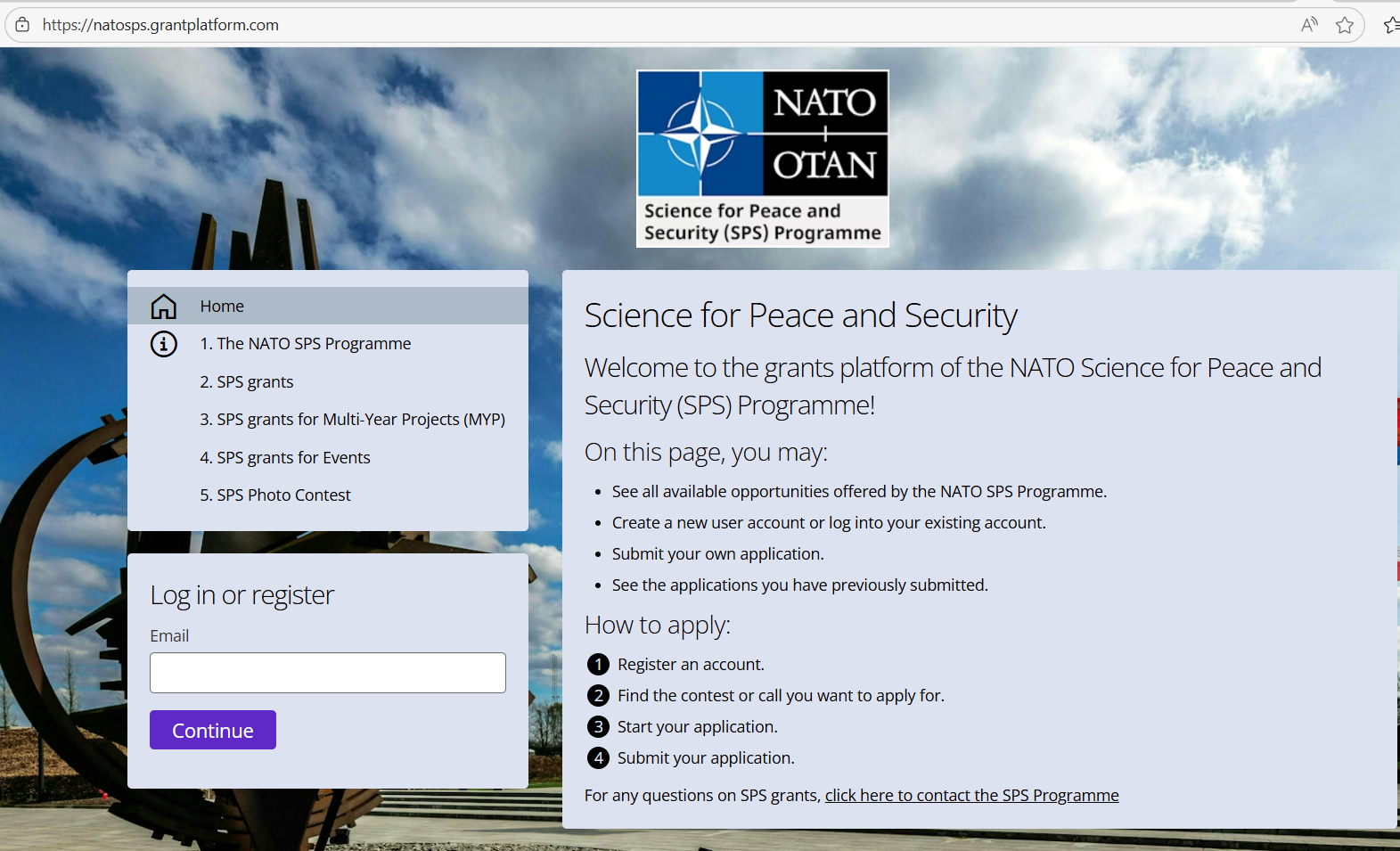
The North Atlantic Treaty Organization (NATO) has launched the Science for Peace and Security (SPS) Programme Call for Proposals 2026-1, inviting eligible applicants to submit project proposals that address contemporary security challenges through civilian science and technology cooperation. The call is open to a wide range of stakeholders from NATO member states and partner countries and aims to strengthen cooperation, build capacity and contribute to international security through research, innovation and policy-relevant activities.
Full proposals for Events and phase 1 proposals for Multi-Year Projects must be submitted before Saturday, 31 January 2026 (23:59 CET) via the SPS grant platform. Data pertaining to incomplete applications will be lost after the deadline.
The SPS Programme is a long-standing NATO instrument designed to promote dialogue and practical cooperation between scientists, experts and institutions from NATO and partner countries. It focuses on non-military research and innovation with clear relevance to security and resilience. Projects supported under the programme are expected to deliver tangible outcomes, such as new knowledge, applied solutions, networks of experts, or enhanced capacities in partner countries.
The 2026-1 call covers several established SPS activity formats. These include Multi-Year Research Projects, which support applied research and technology development; Advanced Research Workshops, which bring together experts to exchange knowledge and identify research and policy priorities; Advanced Training Courses, aimed at capacity building and skills development; and Advanced Study Institutes, which provide in-depth training on emerging topics of relevance to security. All activities must demonstrate clear alignment with SPS priorities and NATO’s strategic objectives.
The thematic scope of the call reflects NATO’s current security agenda.
In line with the Key Priority of Innovation and Emerging Disruptive Technologies (EDTs), SPS welcomes proposals focusing on:
Autonomy, and in particular:
- Autonomous integration of multi-source data for real-time awareness, predictions, and actionable decisions.
- Coordination among multiple autonomous platforms on land, at sea (and undersea), in air and/or across domains.
- Continuity of operations in contested and extreme environments (e.g. GNSS denied spaces, extreme cold, high winds, ice accumulation, solar interference).
- Human-autonomy teaming
Artificial Intelligence (AI), and in particular:
- Convergence of AI with other security-related technologies in view of its cross-cutting nature.
- AI and cognitive influence.
- Human-machine interaction, brain-computer interfaces.
Biotechnologies, and in particular:
- Biosensors (e.g. for CBRN detection, environmental monitoring, disease diagnosis).
- Bioengineering (e.g. chemical synthesis, fuels), biomanufacturing of critical materials or alternatives, or for use in logistically challenging environments.
Space technologies, including:
- Space Situational Awareness.
- Space-based monitoring of the atmospheric, oceanic and space environments.
- Position, Navigation and Timing.
In line with the Key Priority of Defence against Hybrid Threats, SPS welcomes proposals focusing on linkages between military and civilian means to counter hybrid threats, build resilience and the required capabilities.
Eligibility is restricted to civilian applicants. Proposals must be developed jointly by partners from NATO member states and eligible partner countries, ensuring genuine cooperation and mutual benefit. The SPS Programme places particular emphasis on involving partners from regions facing security challenges, as well as on supporting early-career researchers and promoting gender balance where possible. Military-only projects or activities without a clear civilian science and security dimension are not eligible.
Eligible countries
Individuals from the following countries are eligible to participate in activities supported by the SPS Programme:
NATO member countries: Albania, Belgium, Bulgaria, Canada, Croatia, Czechia, Denmark, Estonia, Finland, France, Germany, Greece, Hungary, Iceland, Italy, Latvia, Lithuania, Luxembourg, Montenegro, the Netherlands, the Republic of North Macedonia, Norway, Poland, Portugal, Romania, Slovakia, Slovenia, Spain, Sweden, Türkiye, United Kingdom, United States of America.
Eligible NATO partner countries: Algeria, Armenia, Australia, Austria, Azerbaijan, Bahrain, Bosnia and Herzegovina, Colombia, Egypt, Georgia, Iraq, Ireland, Israel, Japan, Jordan, Kazakhstan, the Republic of Korea, Kuwait, Kyrgyz Republic, Malta, Mauritania, the Republic of Moldova, Mongolia, Morocco, New Zealand, Pakistan, Qatar, Serbia, Switzerland, Tajikistan, Tunisia, Turkmenistan, Ukraine, United Arab Emirates, Uzbekistan
The application process requires the submission of a detailed proposal outlining objectives, relevance to SPS priorities, methodology, expected results, partnership structure, budget and timeline. Proposals are evaluated through a competitive peer-review process based on criteria such as scientific quality, security relevance, feasibility, impact and contribution to NATO partnership objectives. Funding decisions are taken following this evaluation and in line with available SPS resources.
For more information please visit the source page of this announcement: SPS_call-for-proposals_2026-1.pdf and Science for Peace and Security.