
 Search


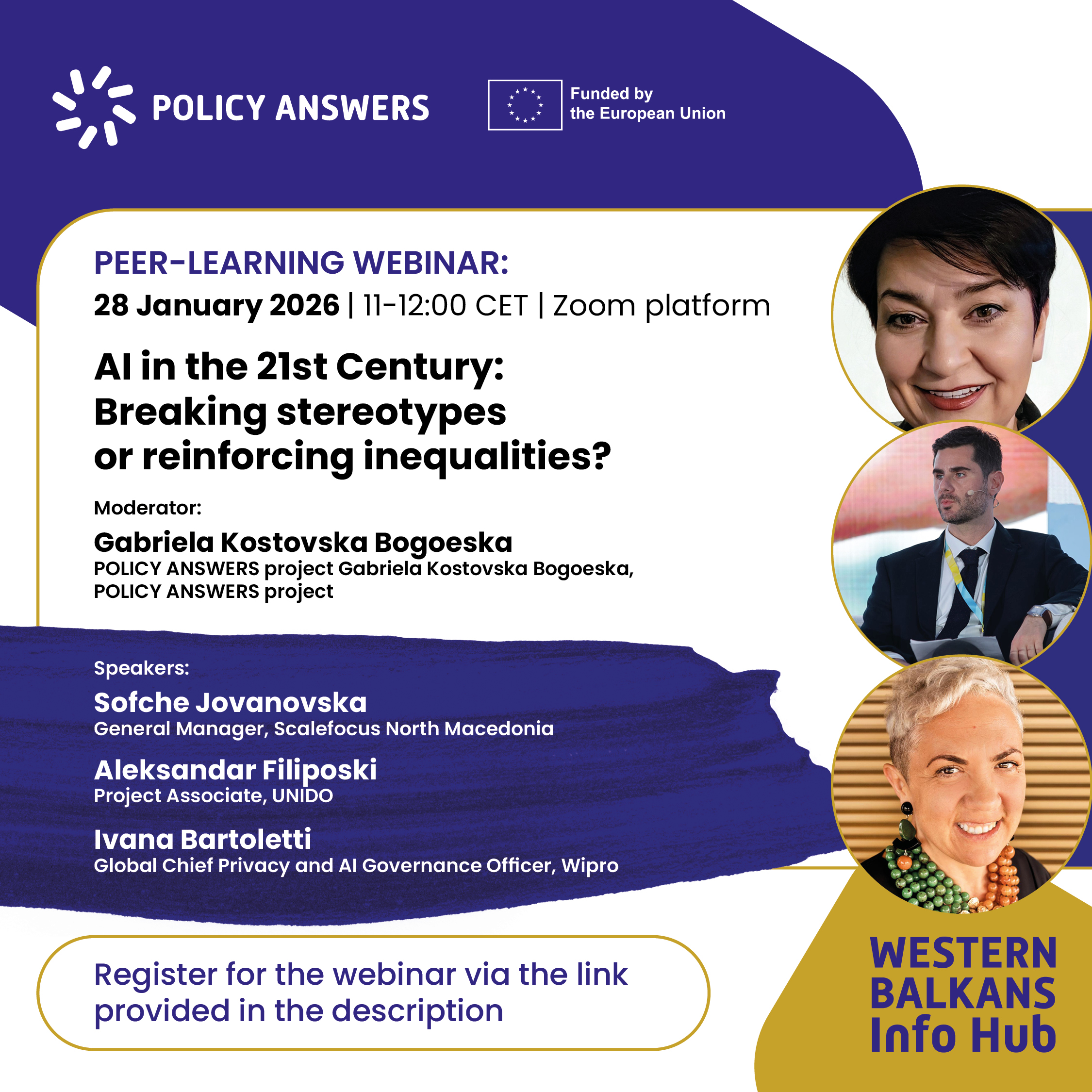
On 28 January 2026, the Foundation for Management and industrial research successfully hosted the peer-learning webinar “AI in the 21st Century: Breaking stereotypes or reinforcing inequalities?” as part of the POLICY ANSWERS: R&I Policy making, Implementation and Support in the Western Balkans project. The online event brought together experts, practitioners, and policymakers to critically examine the role of Artificial Intelligence (AI) in shaping gender equality, ethics, and inclusion in today’s society.
Artificial Intelligence is transforming economies, institutions, and daily interactions. While often perceived as neutral and objective, AI systems reflect human choices, social norms, and historical data, meaning they can inadvertently embed and amplify biases and structural inequalities. Participants explored both the potential of AI to foster positive change and the risks it poses for reinforcing societal stereotypes at an unprecedented scale.
Designed as an interactive peer-learning space rather than a traditional lecture, the webinar featured short expert inputs, followed by dynamic discussion among attendees. The session aimed to facilitate cross-sector dialogue on how inclusive and responsible AI ecosystems can be shaped through informed policy, industry engagement, and leadership commitment.
Key topics discussed included:
- How societal biases are embedded in AI systems and why it matters for business and society;
- The economic and social costs of biased and non-inclusive AI;
- The role of policy, industry, and international organisations in fostering inclusive AI practices;
- Leadership responsibility and the importance of AI literacy in decision-making;
- Opportunities to design fair, ethical, and accountable AI, especially in emerging and developing contexts.
The webinar was moderated by Gabriela Kostovska Bogoeska from the POLICY ANSWERS project at MIR Foundation, who opened the event with reflections on the urgency of addressing bias in AI systems and the importance of cross-disciplinary collaboration.
Speakers included:
Sofche Jovanovska, General Manager at Scalefocus North Macedonia, who shared insights on why AI cannot be treated as neutral and how leadership can drive AI equity.
Aleksandar Filiposki, Project Associate at UNIDO, who highlighted global perspectives on inclusive AI and responsible adoption practices.
Ivana Bartoletti, Global Chief Privacy and AI Governance Officer at Wipro, who discussed power dynamics, gender, and ethics in AI governance beyond technical solutions.
The session concluded with an engaging Q&A and closing remarks, where participants underscored the shared responsibility of governments, businesses, researchers, and civil society in mitigating bias and fostering ethical and inclusive AI systems. The event provided a rich space for exchanging ideas, good practices, and policy approaches, reinforcing that advancing gender equality and inclusion in the age of automation requires holistic and collaborative efforts.
Watch the webinar here: https://www.youtube.com/watch?v=QYuQjnn6L5Q&t=1399s