
 Search


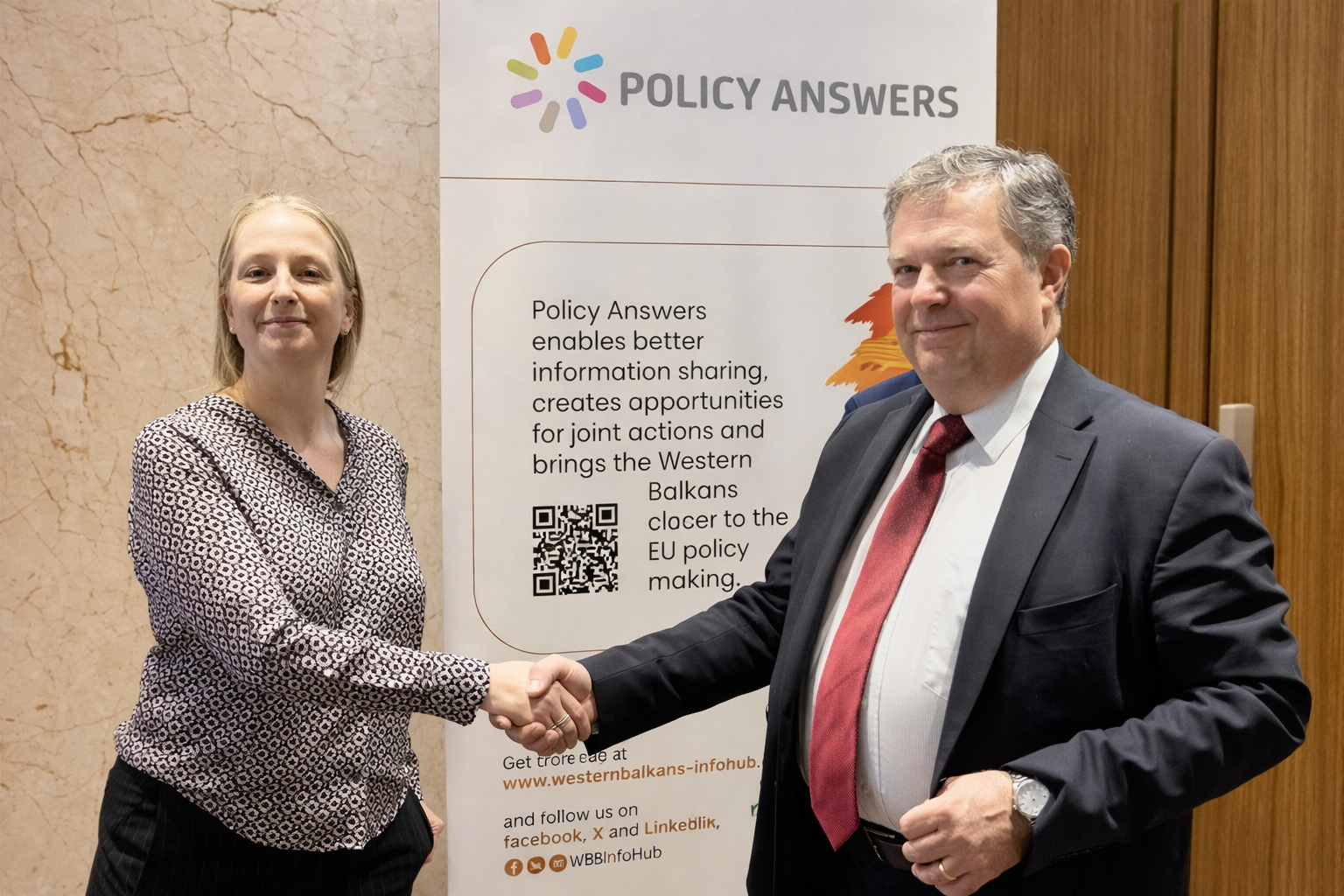
As POLICY ENLARGE gets under way, we spoke with project coordinator Béla Kardon about what this new project means for the region, and what he is most looking forward to.
POLICY ANSWERS: You are taking over coordination of the POLICY ANSWERS follow-up project at an interesting moment for EU enlargement and also the regional outlook of the project has changed: the project now covers ten economies instead of the Western Balkans six. How do you approach that?
Béla: I see POLICY ENLARGE very much as a project of both continuity and adaptation. We are not starting from scratch: we are building on the strong foundations of POLICY ANSWERS, especially its trusted policy-dialogue formats, networks and knowledge base. At the same time, moving from the Western Balkans six to ten enlargement economies means that we must be more flexible and more differentiated in how we work.
Our approach is therefore to preserve what already works, while extending it intelligently. We will continue to use proven mechanisms such as the Western Balkans Steering Platforms and their ministerial meetings, but we will complement them with a variable-geometry approach: sometimes bringing all ten economies together, and sometimes working in smaller thematic or regional configurations, depending on the policy issue and the needs of the partners. This allows us to combine regional coherence with targeted support, and to help the different enlargement economies move forward at their own pace while still advancing towards the same broader goal: deeper integration into the European Research Area and the wider European knowledge ecosystem.
What other novelties does POLICY ENLARGE introduce that were not present under the now-ending POLICY ANSWERS project?
Béla: One important point is that POLICY ENLARGE does not start from zero in this area. POLICY ANSWERS already piloted financial support through the Western Balkans Innovation Vouchers and the Western Balkans Mobility Scheme, and POLICY ENLARGE builds directly on those lessons. What is new is the scale, structure and ambition of the new Financial Support to Third Parties (FSTP) scheme under WP3 that will operate across all ten enlargement economies through one open call with three funding instruments — for Joint Regional Innovation Actions, Collaborative Uptake of Results, and People-to-People Cooperation Projects.
So the novelty is not the existence of FSTP as such, but the fact that it becomes a much more central and strategic part of the project. POLICY ENLARGE will support up to 45 cross-border projects and mobility actions, with a simpler lump-sum model, several cut-off dates and a user-friendly process designed to make participation easier and more flexible. In this way, the project moves one step further from policy dialogue alone towards practical experimentation, collaboration and uptake, helping stakeholders across the enlargement region to connect more closely with EU research and innovation activities.
The Western Balkans Info Hub as well as the active social media presence have been key assets of POLICY ANSWERS. How do you see communication and dissemination evolving under POLICY ENLARGE?
Béla: Communication and dissemination were already among the great strengths of POLICY ANSWERS, and in POLICY ENLARGE we want to build on that legacy in a more strategic and forward-looking way. The Western Balkans Info Hub will evolve into a broader Enlargement Info Hub, reflecting the project’s expanded geographical scope while preserving the visibility, continuity and trust that the platform has built over many years. It will remain the central entry point for news, opportunities, policy developments, project results and practical resources related to research, innovation, education and EU integration in the enlargement region.At the same time, we want communication to be even more closely linked to impact. That means not only publishing information, but also tailoring messages to different audiences — policymakers, universities, research organisations, businesses, innovation intermediaries, civil society and the wider public. POLICY ENLARGE will combine the Hub, newsletters, social media, videos, infographics, events and stakeholder mapping into one coherent communication, dissemination and exploitation strategy. In this way, communication will not be a parallel activity, but a real instrument for outreach, engagement, uptake of results and stronger regional ownership.
What is your biggest hope for POLICY ENLARGE three years from now?
Béla: My biggest hope is that, three years from now, we will be able to say that POLICY ENLARGE has helped bring the research and innovation policies of the enlargement economies closer to EU policies and priorities in a practical and lasting way. For me, success would mean not only stronger dialogue and better policy coordination, but also clearer alignment with the European Research Area, the European Innovation Agenda and other key EU frameworks, so that partners in the region are better connected, better prepared and more confident in working within the European knowledge ecosystem.
I would also very much like to see a visible improvement in participation in the EU framework programmes. POLICY ENLARGE is designed to strengthen capacities, improve networking, and optimise the participation and impact of Horizon Europe and its successor programme (FP10) across the region. If, by the end of the project, more institutions from the enlargement countries are joining stronger consortia, winning more proposals, and taking a more active role in European research and innovation cooperation, I would consider that a very meaningful achievement.