
 Search


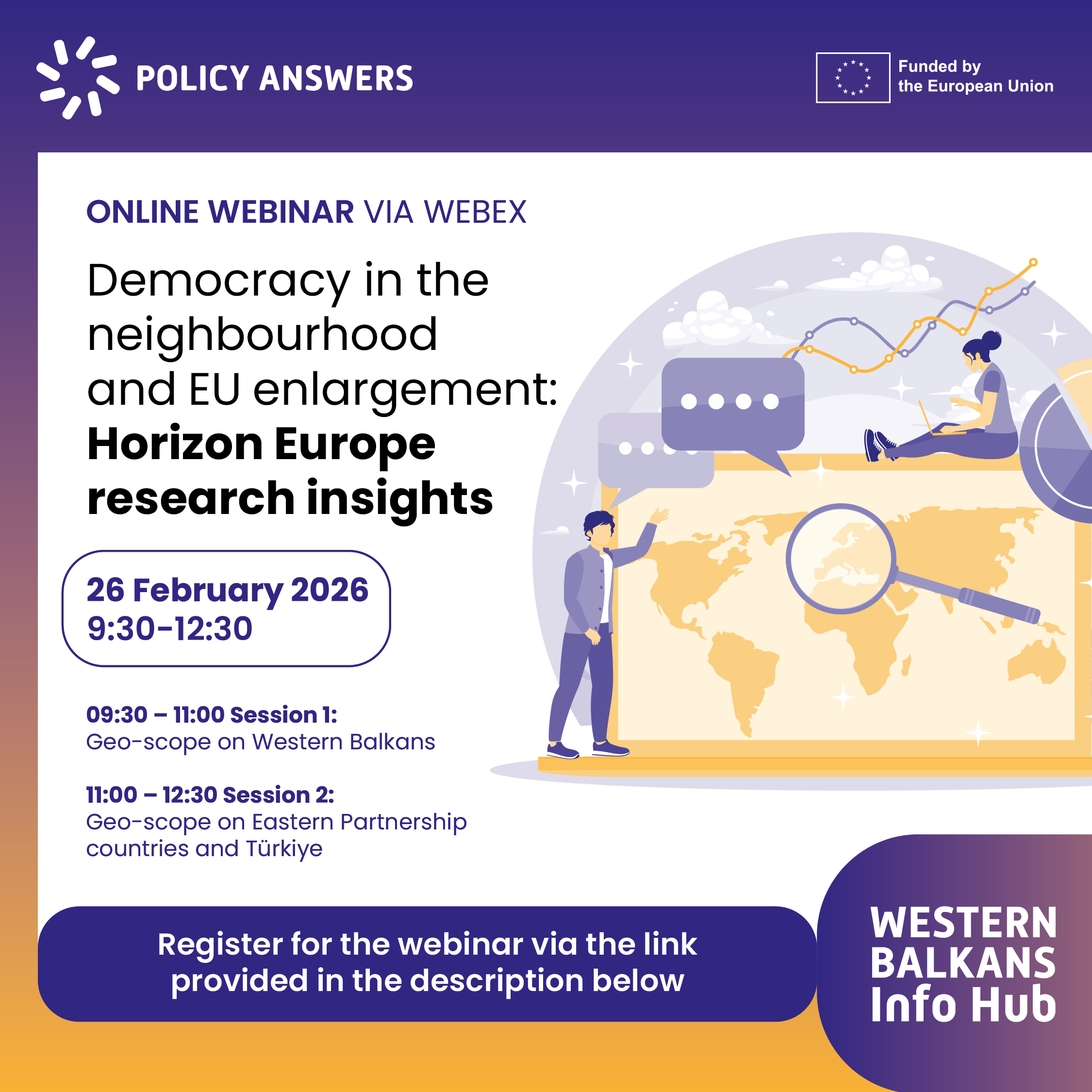
At a moment when EU enlargement and neighbourhood policy are shaped by overlapping democratic, geopolitical and security challenges, this webinar offers a rare opportunity to engage directly with cutting-edge Horizon Europe research that speaks to the fundamentals of democratic governance.
The webinar is organised on 26 February 2026 and offers:
- A clearer understanding of structural and political constraints and how these interact with EU accession processes.
- Evidence-based insights supporting more informed debate and policy reflection.
- Comparative perspectives across regions to identify common patterns, divergences, and context-specific dynamics that are often overlooked in country-by-country assessments.
- Direct access to Horizon Europe project teams, allowing for dialogue between researchers, policymakers and civil society actors on how empirical findings can inform EU policy design, implementation and evaluation.
This online webinar brings together multiple leading Horizon Europe research projects working on democracy, governance and enlargement-related issues in a single forum. They are invited to present comparative evidence and policy-relevant analysis on democratic developments in the Western Balkans, the Eastern Partnership countries, and Türkiye. The event is designed to contribute research-based perspectives that are highly relevant for the EU’s current and forthcoming enlargement package and broader neighbourhood policy debates.
The focus of the webinar is on core democracy-related challenges, addressed through empirical research and comparative analysis, including:
- Transitional and hybrid regimes, and respect for human rights, non-discrimination and minority rights
- Corruption and organised crime
- Media freedom, pluralism and freedom of expression
- Disinformation, foreign interference and the freedom of scientific research
- EU accession and the fundamentals, including the rule of law and the judiciary
The webinar is structured around two geographically focused sessions. Each session will feature short presentations by Horizon Europe project representatives, followed by moderated discussion and audience Q&A
Opening Remarks
Maria Pilar Aguar Fernandez, Director of the Directorate ‘People:Health and Society’, DG Research and Innovation, European Commission
Panel discussion 1: Western Balkans (09:30–11:00)
Moderated by Anne Haglund-Morrissey, Deputy Head of Unit ´Democracy, Equality and Culture´, DG Research and Innovation, European Commission
- Sonja Grimm – Overview of the current accession process; comparative analysis of progress and setbacks among candidate states; examination of the strategic role of key candidates in the enlargement process [EMBRACE project]
- Anamarija Velinovska – Comparative case studies across accession and neighbouring contexts; analysis of how disinformation becomes politically effective when adopted by domestic elites; implications for democratic resilience and enlargement dynamics [GEO-POWER.EU project]
- Morten Bøås – Transitional and hybrid regimes; respect for human rights, non-discrimination, and minority rights [RE-ENGAGE project]
- Florian Bieber – Countering external influence through democracy promotion; restoring credibility through democratic conditionality; the geopolitical turn in enlargement policy; the role of the EU as a global promoter of democracy [REUNIR project]
Panel discussion 2: Eastern Partnership (Ukraine, Moldova, Georgia) and Türkiye (11:00–12:30)
Moderated by Alberto Domini, Policy Officer, Unit ´Democracy, Equality and Culture´, DG Research and Innovation, European Commission
- Karina Shyrokykh – Diffusion of illiberal legislation as a pathway to autocratization in neighbouring and accession contexts; enlargement to the East between geopolitical pressures and a merit-based process [EMBRACE project]
- Maryna Rabinovych – Analysis of authoritarian influence through disinformation and propaganda; narratives undermining democracy and challenging Western normative power; evidence of democratic erosion driven by weakened rule of law and judicial independence; recommendations on investing in societal resilience, strengthening strategic communication, long-term technical assistance, support for local watchdogs, tailored conditionality, and regime-sensitive democracy support; overview of EU funding for rule of law, human rights, and good governance [REDEMOS project]
- Magdalena Góra – Narratives of democracy support within enlargement frameworks; shifts in national approaches following transitions from association to candidacy; key lines of contestation over democracy support among eastern candidate contexts [SHAPEDEM-EU project]
- Funda Tekin – Developments and prospects for rule of law and democracy in stalled enlargement contexts; implications of blocked accession processes; potential of alternative forms of association between the EU and candidate partners [INVIGORATE project]